

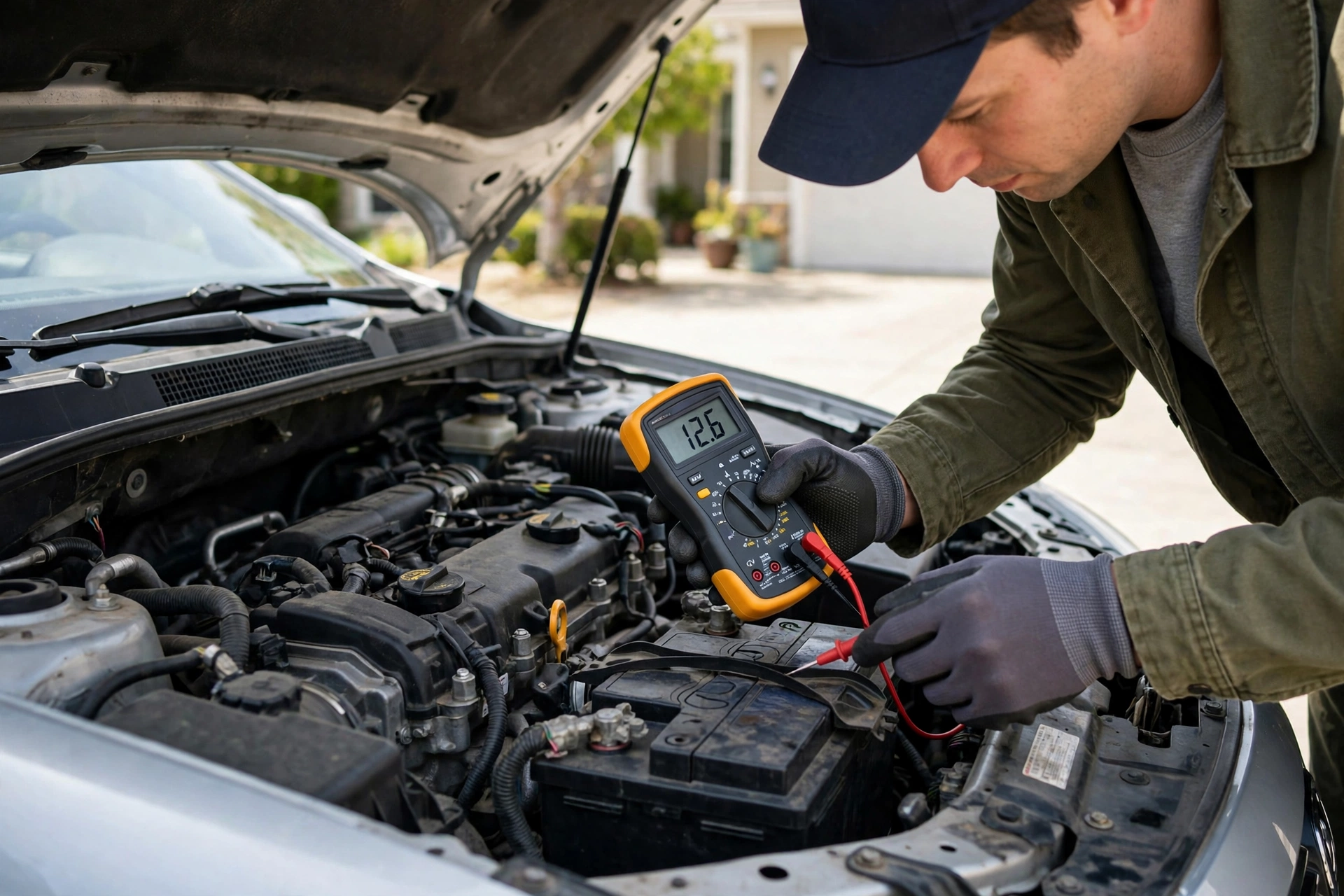
Learning how to test a car battery at home takes about ten minutes and one inexpensive tool: a digital multimeter. A healthy battery reads 12.6 volts or more with the engine off, stays above 9.6 volts while the engine cranks, and charges at 13.7 to 14.7 volts with the engine running. If your readings fall below those numbers, your battery is weak and should be replaced before it leaves you stranded. This guide covers five simple methods, explains what the numbers mean, and tells you what to do next.
Table of Contents
Signs Your Car Battery Needs Testing
Before you learn how to test a car battery at home, it helps to recognise the warning signs of a weak one. Most batteries last three to five years, and they rarely fail without giving you a few hints first:
- The engine cranks slowly, especially on cold mornings.
- Headlights look dim when the engine is off and brighten when it revs.
- You hear a rapid clicking sound when you turn the key.
- The battery warning light stays on after starting.
- The battery case looks swollen, cracked, or covered in white or blue crust.
- Your car needs a jump start more than once in a few weeks.
If you notice one or more of these signs, test the battery right away. Our guide to car battery warning signs explains each symptom in more detail.
Cold weather makes weak batteries fail faster, because cold thickens engine oil and cuts a battery’s cranking power at the same time. That is why autumn is the best time to check yours — read our step-by-step guide to preparing your car for winter.
What You Need to Test a Car Battery at Home
You do not need a garage full of equipment. For the methods in this guide, gather:
- A digital multimeter (about $15 to $25 at any auto parts store)
- Safety glasses and work gloves
- A wire brush or battery terminal cleaner
- A helper, for the cranking test
- A battery load tester (optional, about $30 to $50)
A multimeter is the only tool you truly need. Always test in a well-ventilated area, keep the leads away from moving parts, and never let the red and black probes touch each other while connected to the battery. Those basic precautions are part of learning how to test a car battery at home safely.
Method 1: How to Test a Car Battery at Home with a Multimeter
The multimeter method is the most accurate way to learn how to test a car battery at home, and it takes about five minutes. A digital multimeter measures the battery’s resting voltage, which tells you its state of charge.
- Park on level ground, switch the engine off, and open the bonnet. Wait an hour after driving so the battery settles to its resting voltage.
- Set your multimeter to DC volts, on the 20-volt range.
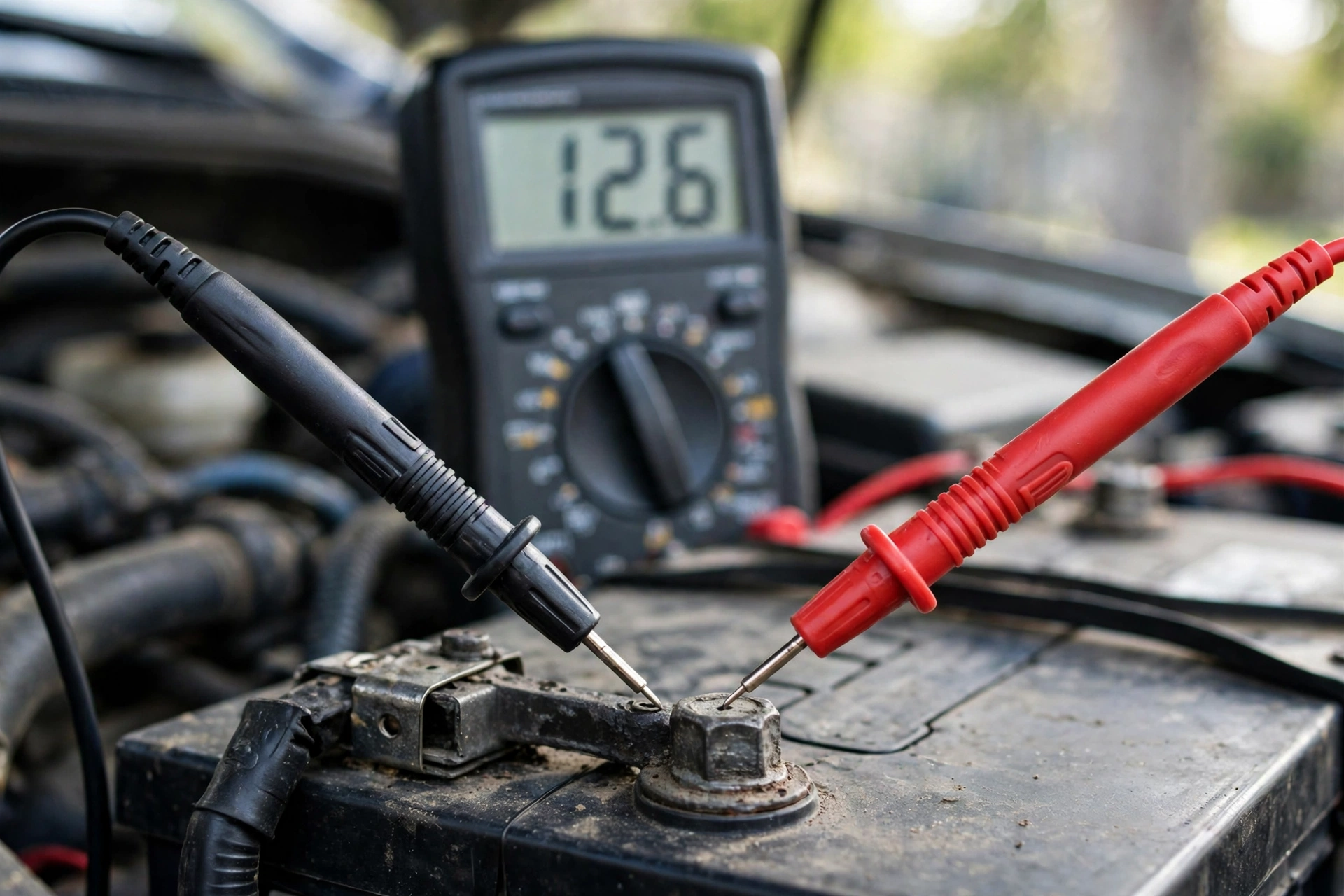
- Touch the red probe to the positive (+) terminal and the black probe to the negative (−) terminal.
- Read the display and compare it with the table below.
A reading of 12.6 volts or more means the battery is fully charged. At 12.4 volts it is about 75 percent charged, and at 12.2 volts it is about half charged. A reading of 12.0 volts or less means the battery is discharged or worn out. Charge it fully and test again — if the reading does not improve, replace the battery. That scale is worth remembering when you are learning how to test a car battery at home.
Method 2: How to Test a Car Battery at Home Without a Multimeter
If you do not own a multimeter, you can still learn how to test a car battery at home with the headlight test. It will not give you a number, but it will tell you whether the battery is holding a charge.
- Switch the headlights on with the engine off and look at their brightness.
- Start the engine while watching the lights. If they dim sharply or go out while cranking, the battery is weak.
- Rev the engine gently. If the lights brighten noticeably, the battery was struggling to hold voltage on its own.
The crank test works the same way: turn the key and listen. A strong battery spins the engine briskly. A weak one turns it over slowly, or you hear a fast clicking sound and nothing else. If your car has already needed a jump start, treat that as a failed test. That quick listen is one of the easiest ways to learn how to test a car battery at home without any tools.
Method 3: How to Test a Car Battery at Home with a Load Tester
A load tester applies a heavy electrical load to the battery — similar to what the starter motor draws — and shows whether the voltage holds up. It finds weak batteries that still show a good resting voltage, which makes it one of the best ways to learn how to test a car battery at home.
- Connect the tester clamps to the terminals: red to positive, black to negative.
- Press and hold the load switch for 10 to 15 seconds.
- Watch the meter. A healthy battery holds above 9.6 volts under load. If the reading drops below that, the battery cannot deliver the power your engine needs.
Some auto parts stores run a load test for free. Let the battery rest a few minutes between tests and never hold the load for more than 15 seconds.

Method 4: The Cranking Voltage Test
For this test you need a multimeter and a helper. Connect the multimeter as in Method 1, then have your helper turn the key while you watch the display. A healthy battery stays above 9.6 volts while the engine cranks. If the voltage drops below that, the battery is too weak to start the engine reliably, even if its resting voltage looked fine. Watching that drop is a useful next step when you are learning how to test a car battery at home.
Method 5: The Charging System Test
A battery can test fine and still go flat if the alternator is not charging it. With the engine running, connect the multimeter to the terminals again. You should see 13.7 to 14.7 volts. Below 13.7 volts, the alternator may be undercharging; above 14.7 volts, it may be overcharging, which can damage the battery. Either way, the charging system needs a mechanic’s attention.
How to Read Your Battery Test Results
- 12.6 volts or more at rest: Fully charged. No action needed.
- 12.4 volts: About 75 percent charged. Recharge and retest.
- 12.2 volts: About 50 percent charged. Recharge and check the battery’s age.
- 12.0 volts or less: Discharged or worn out. Charge and retest; replace it if the reading stays low.
- Below 9.6 volts under load or while cranking: Fails under load. Replace the battery.
- Charging voltage outside 13.7 to 14.7 volts: Charging system fault. See a mechanic.
Once you know how to test a car battery at home, these numbers turn a guess into a decision. A battery that reads 12.4 volts in summer might still start your car, but the same battery in January — when cold cuts its power in half — may not. When in doubt, replace a battery that is more than four years old and tests below 12.4 volts. A new battery costs far less than a tow truck.
What to Do If Your Battery Fails the Test
If your battery fails the test, knowing how to test a car battery at home has already saved you from a breakdown on a cold morning. Here is what to do next:
- Charge the battery fully with a battery charger, then test it again. A battery that holds 12.6 volts after charging may have simply gone flat from short trips or a light left on.
- If it still reads below 12.4 volts after charging, replace it. Check the group size and cold-cranking amps in your owner’s manual, and match or exceed the original rating.
- Clean the terminals before fitting the new battery. Corrosion adds resistance and makes even a new battery look weak.
- Recycle the old battery. Most auto parts stores take old batteries for free.
If you are buying a used car, a battery test belongs on your inspection list. Our used car inspection checklist covers the battery and 24 other things to check before you pay.
How Often Should You Test Your Car Battery?
Most drivers only need to run this test twice a year — in autumn, before the cold arrives, and in spring, after winter has worn the battery down. Test it sooner if you notice slow cranking, dim lights, or a battery that is more than three years old. Drivers who only make short trips should test more often, because short drives never fully recharge the battery. Add the test to your seasonal routine — our cold-weather car maintenance checklist has the full list, and our winter driving tips will help you stay safe once the snow arrives.
Frequently Asked Questions
Can I test a car battery at home without any tools?
Yes. The headlight test and the crank test in Method 2 need no tools at all. They will not give you an exact voltage, but they will show whether the battery is holding a charge. For an exact reading, a multimeter is the cheapest reliable option. In short, you can learn how to test a car battery at home for free, then use a multimeter when you want an exact number.
What voltage should a good car battery read?
A good car battery reads 12.6 volts or more with the engine off, stays above 9.6 volts while cranking, and charges at 13.7 to 14.7 volts with the engine running.
How long does a car battery last?
Most car batteries last three to five years, according to AAA. Heat, cold, short trips, and long periods parked all shorten battery life. Learning how to test a car battery at home twice a year is the simplest way to catch a dying battery before it strands you.
Can a weak battery still start my car?
Sometimes, yes — especially in warm weather. But a weak battery is living on borrowed time. Cold weather can cut its available power in half, so a battery that starts your car in October may fail in January. If your test shows less than 12.4 volts, replace it before winter.
Should I test the battery or the alternator first?
Test the battery first. If the resting voltage is low, charge the battery and test again. If the battery holds a charge but the running voltage is outside 13.7 to 14.7 volts, the alternator or charging system is the problem.
Quick Summary
- A healthy battery reads 12.6 volts or more at rest, above 9.6 volts while cranking, and 13.7 to 14.7 volts while charging.
- A multimeter gives the most accurate result; the headlight and crank tests work without any tools.
- Learning how to test a car battery at home takes ten minutes and one cheap tool.
- Test twice a year — autumn and spring — and sooner if you notice slow cranking or dim lights.
- A battery below 12.4 volts after charging should be replaced, especially before winter.
Conclusion
Now you know how to test a car battery at home — with a multimeter, a load tester, or no tools at all. The test takes ten minutes, costs little or nothing, and tells you whether your battery will start on the coldest morning of the year. Test yours this weekend, before a weak battery chooses the worst possible moment to quit.
[…] takes only a few minutes. For step-by-step testing methods you can do yourself, see our guide on How to Test a Car Battery at Home. You can also read our full list of Car Battery Warning Signs Every Owner Must Watch For to catch […]
[…] does matter is charging a very cold battery at high speed. That is why most EVs limit fast-charging power when the battery is cold, and why […]