

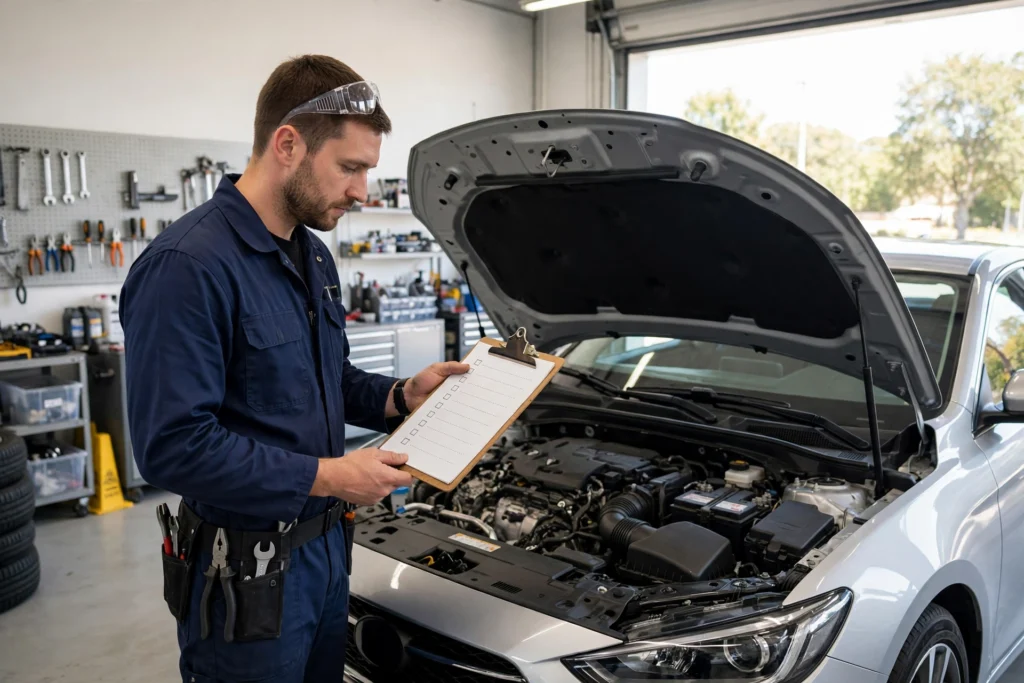
A car maintenance schedule by mileage is the simplest way to know what your car needs and when. Instead of guessing, you service parts at set mileage marks — oil at one point, filters at another, brakes and belts later on. Follow it, and your car stays reliable, safer, and cheaper to run.
Table of Contents
Most cars share the same basic pattern, even though exact intervals vary by make and model. Your owner’s manual always has the final word, but the schedule below covers what nearly every petrol or diesel car needs, from the first oil change to the 100,000-mile service. Use it as your starting point, then adjust it to your car.
Why a Car Maintenance Schedule by Mileage Works
Cars wear out by use, not by the calendar alone. A car that covers 20,000 miles a year ages far faster than one that covers 5,000. That is why a car maintenance schedule by mileage beats a vague “service it once a year” habit: it matches the work to the wear.
Sticking to a mileage-based plan has three clear benefits. First, it catches small problems early — a worn belt or low fluid costs little to fix before it fails. Second, it protects your car’s value, because a full service history is one of the first things buyers check. Third, it saves money: regular servicing costs far less than the breakdowns it prevents.
The Mileage Intervals at a Glance
Here is the whole plan in one view. The sections below explain each step in detail.
- Every 5,000 miles: engine oil and filter, tyre pressure and tread, fluid levels, lights
- Every 10,000 miles: air filter check, tyre rotation, wiper blades, battery test
- Every 15,000 miles: cabin air filter, fuel filter check, brake inspection
- Every 30,000 miles: transmission fluid, coolant, spark plugs (some cars), brake fluid
- Every 60,000 miles: timing belt check, suspension inspection, drive belts
- Every 90,000–100,000 miles: timing belt replacement, spark plugs, major service
- Every 12 months: anything time-sensitive, even if the miles are low
Every 5,000 Miles: Oil, Tyres and Fluids
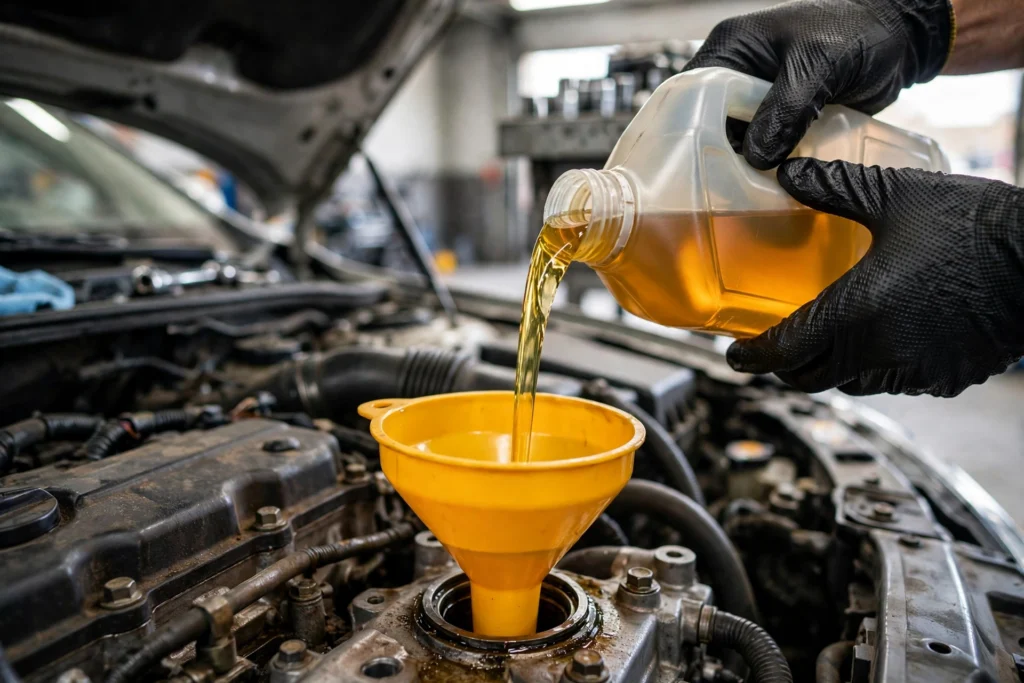
The 5,000-mile visit is the backbone of any car maintenance schedule by mileage. Engine oil is the single most important item: it lubricates moving parts, carries heat away, and traps dirt. Old oil turns thick and dirty, and an engine running on it wears out faster.
At this visit, change the oil and the oil filter together. Check the tyre pressure and tread depth, top up coolant, brake fluid, washer fluid and power steering fluid, and test every light. It takes under an hour, and it is the cheapest insurance your engine will ever get.
Many modern cars stretch oil changes to 7,500 or even 10,000 miles with synthetic oil. That is fine — but only if your manual says so. Short trips, stop-and-go traffic and dusty roads all count as severe driving, and severe driving shortens the interval. When in doubt, change it sooner.
Every 10,000 Miles: Filters, Rotation and Battery
By 10,000 miles, a few more jobs join the list. Rotate the tyres so they wear evenly — front tyres wear faster on most cars, and rotation can add thousands of miles to a set. Inspect the engine air filter; a clogged filter hurts fuel economy and performance.
This is also a good time to test the battery. At this point in your car maintenance schedule by mileage, a weak battery is worth catching early: it often gives no warning before it fails, and a simple voltage test takes a minute. If you want to understand what a healthy battery looks like, our guide on how long a car battery lasts explains the warning signs to watch for, and you can also learn how to test a car battery at home with basic tools.
Check the wiper blades too. Streaking or skipping means they are done, and new blades are one of the cheapest safety upgrades you can buy.
Every 15,000 Miles: Cabin Filter and Brakes
At 15,000 miles, the car maintenance schedule by mileage adds the cabin air filter and a proper brake inspection. Replace the cabin air filter — the one that cleans the air coming through your vents. A dirty cabin filter makes the air conditioning work harder and can leave a musty smell inside the car. It is a five-minute job on most cars.
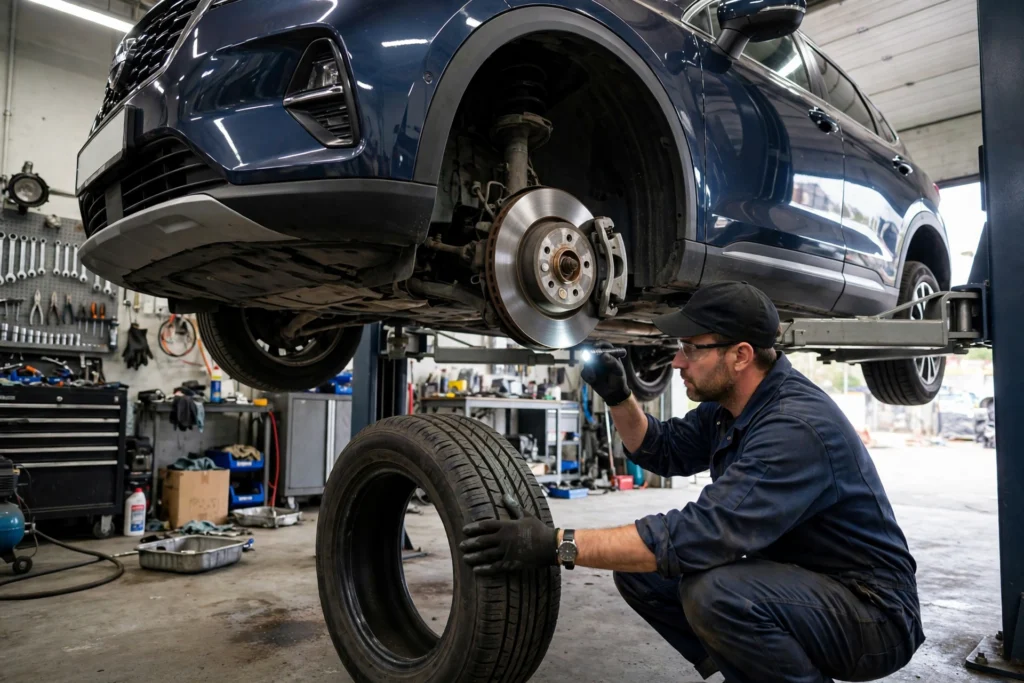
Have the brakes properly inspected at this point: pad thickness, disc condition and brake fluid level. Brakes wear gradually, so you may not notice the change until they are badly worn. A proper inspection at every 15,000 miles keeps them safe. If your car uses winter tyres, this is also a good moment to compare winter tyres vs all-season tyres and decide which set suits your driving.
Every 30,000 Miles: Fluids and Spark Plugs
The 30,000-mile service is a bigger one, and it is where a car maintenance schedule by mileage really pays off. Transmission fluid, coolant and brake fluid all need attention around this mark. Coolant prevents overheating and corrosion; old coolant loses those abilities. Brake fluid absorbs moisture over time, which lowers braking performance.
Spark plugs usually last 30,000 miles on older cars, though many modern iridium plugs last 60,000 to 100,000 miles. Your manual will state the interval for your engine. Worn plugs cause rough idling, poor fuel economy and hard starts, so do not skip them.
This is also the point to check the fuel filter and the drive belts for cracks or glazing. A snapped belt can leave you stranded, and a failed cooling system is one of the main reasons cars overheat — knowing what to do when your car overheats is useful, but fresh coolant and good hoses make it far less likely to happen.
Every 60,000 Miles: Belts, Suspension and Steering
By 60,000 miles your car has done serious work, and a car maintenance schedule by mileage shifts here from routine checks to bigger wear items. Inspect the suspension — shock absorbers, struts and bushings — for wear, leaks or knocking noises. Worn suspension hurts handling and braking, and it wears tyres unevenly.
Check the drive belts and the timing belt. The timing belt is critical: if it snaps, it can destroy the engine on many cars. Some cars use a timing chain instead, which usually lasts the life of the engine, but the belt — where fitted — must be checked at this point and replaced before it fails.
Inspect the steering and wheel alignment too. If the car pulls to one side or the steering wheel sits off-centre, get the alignment checked. It saves your tyres and keeps the car stable at speed.
90,000 to 100,000 Miles: The Major Service
The 90,000 to 100,000-mile service is the biggest scheduled visit most cars ever get. On many cars this is when the timing belt is replaced, along with the water pump, tensioners and spark plugs. It is expensive, but it is far cheaper than an engine rebuild after a belt failure.
At this stage, expect a full inspection: hoses, engine mounts, exhaust, fuel lines and the cooling system. Cars that reach this mileage with a complete service history are worth more and break down less. It is also a sensible time to check for any open recalls — our guide on how to check car recalls by VIN shows five free ways to do it in minutes.
Time vs Mileage: Which Comes First?
A car maintenance schedule by mileage always comes with a time limit as well, usually written as “every 10,000 miles or 12 months, whichever comes first.” Low-mileage cars still need servicing, because oil degrades, rubber perishes and fluids absorb moisture even when the car sits still.
If you drive less than 5,000 miles a year, follow the time side of the schedule. Treat the time limit as part of your car maintenance schedule by mileage, not an optional extra. Change the oil at least once a year, check the battery every six months, and inspect the tyres for cracks — not just tread depth — because old rubber hardens with age. Short trips are especially hard on an engine, since it rarely reaches full operating temperature, so low-mileage cars are not automatically low-maintenance cars.
How to Build Your Own Car Maintenance Schedule by Mileage
You do not need a spreadsheet to follow a car maintenance schedule by mileage. A simple notebook, a phone reminder or a notes app is enough. Here is how to set yours up:
- Open your owner’s manual and note the service intervals for your exact model.
- Write down your current mileage and the date.
- Work out the next three service points — for example, 45,000, 50,000 and 60,000 miles.
- Set a reminder for each one, a few hundred miles before it is due.
- Keep every receipt and stamp the service book after each visit.
- After each service, note anything the mechanic flagged for next time.
If you bought the car used and have no service history, start with a full inspection and a fresh oil change, then follow the schedule from your current mileage. That resets the clock and gives you a clean baseline.
Common Mistakes to Avoid
Most problems come from drifting away from your car maintenance schedule by mileage, not from following it too closely. The five mistakes below are the ones mechanics see most often:
- Skipping oil changes to save money. A skipped oil change saves a small amount now and risks an engine later.
- Ignoring the manual. Generic advice is a guide, not a replacement for your manufacturer’s intervals.
- Only servicing when something breaks. By then, the repair is usually bigger and more expensive.
- Forgetting tyres and brakes. They are wear items, and they wear silently until they are dangerous.
- Using the wrong oil or coolant. Always match the grade your manual specifies.
Frequently Asked Questions
How often should I follow a car maintenance schedule by mileage?
Follow it at every interval your manual lists, usually starting at 5,000 or 10,000 miles. The exact numbers vary by make and model, so your owner’s manual is the final authority. A car maintenance schedule by mileage works best when you treat the intervals as deadlines, not suggestions.
Is a car maintenance schedule by mileage the same for every car?
No. The pattern is similar — oil, filters, fluids, belts and plugs — but the mileage points differ. Diesel cars, hybrids and electric cars have different needs, and some manufacturers specify longer intervals. Always check your manual first.
What happens if I miss a scheduled service?
One missed service rarely causes damage, but the risk grows with every one you skip. Missed oil changes cause sludge, missed coolant changes cause corrosion, and a missed timing belt can destroy an engine. If you have missed several services, book a full inspection and catch up.
Does following the schedule really save money?
Yes. Routine servicing is one of the cheapest forms of car ownership. The NHTSA advises owners to follow the manufacturer’s maintenance schedule, and a full service history also adds resale value when you sell the car.
Should I service my car at a dealer or an independent garage?
Either is fine, as long as the work is done properly and recorded. Dealers know your model best, while independent garages are often cheaper. Keep the receipts either way — they prove the car maintenance schedule by mileage was followed.
Quick Summary
- A car maintenance schedule by mileage tells you what to service and when, matched to how much the car is actually used.
- Oil and filter every 5,000 to 10,000 miles; filters, rotation and battery checks by 10,000 to 15,000 miles.
- Fluids, spark plugs and brakes around 30,000 miles; belts, suspension and steering by 60,000 miles.
- Timing belt and major service at 90,000 to 100,000 miles.
- Follow the time limit as well as the mileage — whichever comes first.
- Keep every receipt: a full service history protects your car and its value.
Conclusion
A car maintenance schedule by mileage takes the guesswork out of car care. You know what is due, when it is due, and why it matters — and that is all it takes to keep a car reliable for years. Start from your current mileage, follow your manual’s intervals, and keep a record of every service. Your car, your wallet and your future buyer will all thank you for it.
[…] makes knowing how to tell if tyres need replacing second nature. Add a tyre check to your regular car maintenance schedule by mileage, so it happens alongside oil changes and other routine work. Also check your tyres before a long […]
[…] your first service. Add the car to your car maintenance schedule by mileage so oil changes and inspections happen on […]