

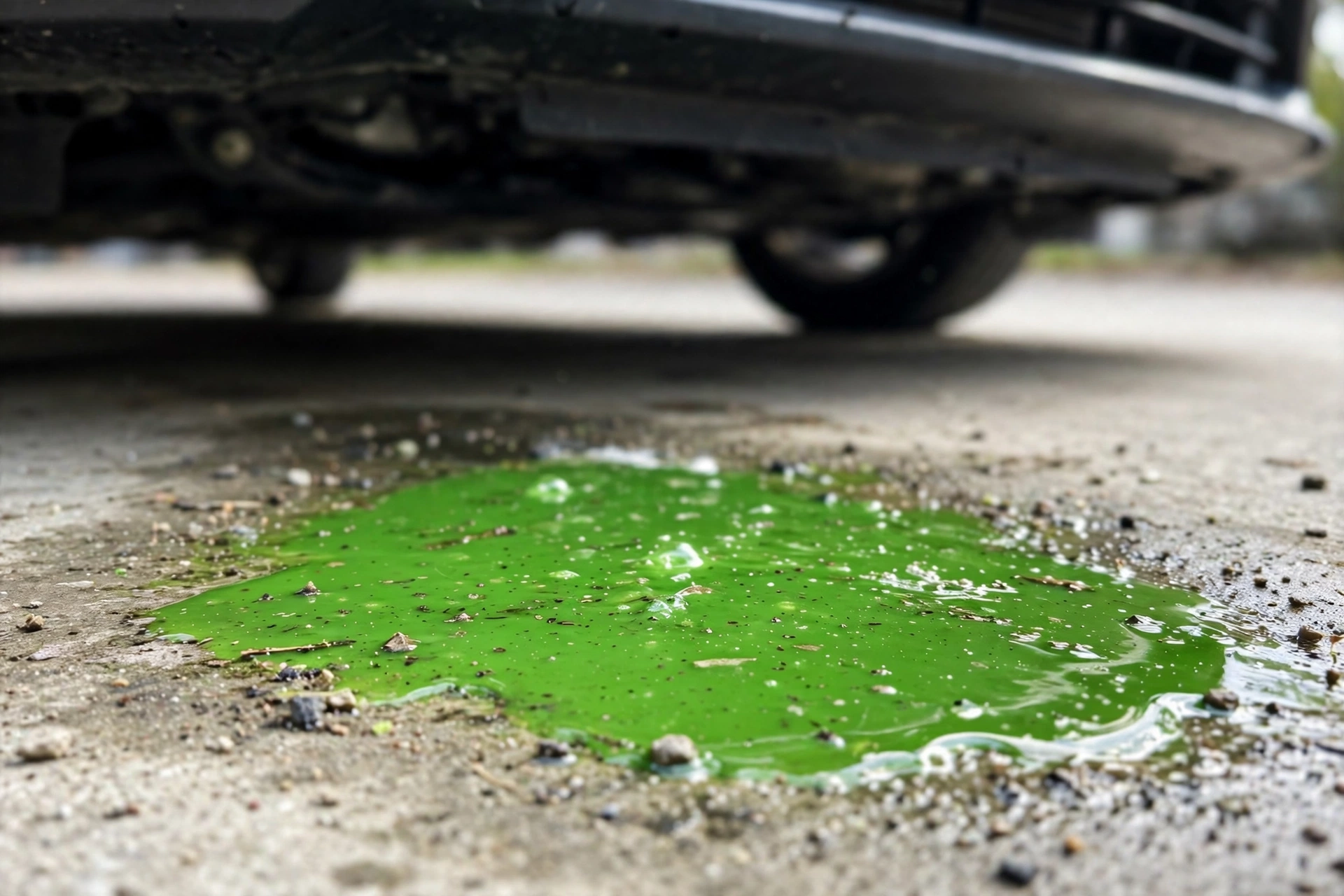
Seeing a bright green, yellow, or pink puddle under your car is a warning sign. A car leaking coolant can overheat fast, and an overheated engine can suffer serious damage in minutes. The good news is that most coolant leaks are easy to find once you know where to look, and many are cheap to fix if you catch them early. In this guide, you will learn the 10 most common causes of a car leaking coolant, how to find the leak yourself, whether it is safe to drive, and how much the repair usually costs.
Table of Contents
How to Tell If Your Car Is Leaking Coolant
Before you look for the cause, make sure the leak is really coolant. The clearest sign is a bright green, yellow, pink, or orange puddle under the front of the car. Other signs include a sweet smell when the engine is hot, the coolant level dropping in the reservoir, the temperature gauge climbing, white steam from under the bonnet, and the heater blowing cold air.
Check the coolant reservoir first: if the level is low and falling, coolant is going somewhere. If you notice a sweet smell, read our guide to car smells and what they mean. A car leaking coolant does not always leave a puddle — a slow leak can evaporate on hot engine parts before it ever reaches the ground.
What Causes a Car to Leak Coolant: 10 Causes
Why is my car leaking coolant? In most cases, the answer is one of these 10 parts. Hoses and seals wear out with age and heat, and they are the cause of most leaks.

1. Damaged Radiator
The radiator sits at the front of the car and cools the coolant with airflow. Stones, corrosion, and age can crack it or damage its fins, and coolant leaks out at the front of the engine bay. A damaged radiator often leaks more when the engine is hot and the cooling system is under pressure.
2. Cracked or Worn Hoses
Rubber hoses carry coolant between the engine, radiator, and heater. Heat makes them hard and cracked over time, and they can split or leak at the ends. A hose leak often shows as a coloured puddle near the front of the engine, and the hose feels soft or swollen when you squeeze it.
3. Water Pump Failure
The water pump pushes coolant through the engine. When its seals wear out or its bearings fail, coolant leaks from the front of the engine, usually near the middle. A failing water pump often makes a whining or grinding noise first, and the leak gets worse quickly.
4. Heater Core Leak
The heater core is a small radiator inside the cabin that warms the air for the heater. When it leaks, coolant gets inside the car instead of under it. The signs are a sweet smell inside, foggy windows, and a wet front footwell on the passenger side.
5. Blown Head Gasket
The head gasket seals the engine block to the cylinder head. When it fails, coolant can leak into the engine and burn, or leak outside. A blown head gasket is the most serious coolant leak: white smoke from the exhaust, milky oil on the dipstick, and rapid overheating are the warning signs.
6. Faulty Radiator Cap
The radiator cap holds the cooling system under pressure. If its seal is worn or its spring is weak, coolant escapes as steam or overflows into the reservoir and out onto the ground. It is the cheapest leak to fix, and it is often the first thing a mechanic checks.
7. Thermostat Housing Leak
The thermostat housing holds the thermostat where the top hose meets the engine. Its gasket hardens with age and heat, and coolant seeps out around the housing. You will usually see dried coloured stains around the housing, near the top of the engine.
8. Cracked Coolant Reservoir
The plastic reservoir holds extra coolant and lets it expand when hot. Age and heat make the plastic brittle, and it can crack and leak. A cracked reservoir is easy to spot: the coolant level drops, and you can often see the crack or the stain running down the tank.
9. Loose Hose Clamps or Connections
Hoses are held on by metal clamps, and clamps loosen with vibration and heat cycles. A loose clamp lets coolant seep out at the joint, even when the hose itself is fine. Tightening or replacing a clamp is a five-minute fix that solves many small leaks.
10. Corroded Freeze Plugs
Freeze plugs are metal discs in the side of the engine block that seal the casting holes. Old coolant that was never changed turns acidic and eats through them from the inside. A corroded freeze plug leaks coolant from the side of the engine, and replacing it means removing parts to reach it.
What Colour Is the Leak?
Not every puddle under a car is coolant, and the colour tells you what it is. Coolant is the only fluid that is bright green, yellow, or pink, so a car leaking coolant is easy to spot once you know the colours. Engine oil is brown or black and feels slippery. Transmission fluid is red or pink. Clear water is usually just condensation from the air conditioning, which is normal. If you are not sure what fluid is leaking, this guide to automotive leaks explains how to tell them apart. If you are not sure whether the puddle is coolant or water, wipe some on white paper: coolant leaves a bright coloured stain, water leaves almost nothing.
Where Is the Coolant Leaking From?
The position of the puddle points to the cause. Coolant at the front of the car usually comes from the radiator or the hoses. Coolant in the middle points to the water pump. Coolant inside the cabin means the heater core. Coolant underneath, near the back of the engine, can come from the reservoir or the freeze plugs. To find a car leaking coolant, slide a piece of cardboard under the car overnight and mark where the drops fall — it makes the leak much easier to find, and it helps your mechanic too.
Car Leaking Coolant When Parked
Most leaks show up when the car is parked, because the coolant settles and drips while the engine is off. A few drops overnight is a small leak; a puddle the size of your hand means the leak needs attention soon. Check the ground in the morning before you drive: the size, colour, and position of the spot tell you how serious it is. A car leaking coolant when parked is also easier to diagnose, because the puddle sits right under the source.
Coolant Leaking Inside the Car
A car leaking coolant inside the cabin usually has a failed heater core. The signs are hard to miss: a sweet smell when the heater is on, windows that fog up and will not clear, and a wet or sticky front footwell on the passenger side. Do not ignore it — the coolant is hot, the leak will get worse, and the heater will stop working. This is a mechanic’s job, because the heater core sits behind the dashboard.
Car Losing Coolant But No Leak
Sometimes the coolant level drops but there is no puddle at all. A car leaking coolant into the engine burns it as white smoke from the exhaust, which usually means a blown head gasket. A faulty radiator cap can also let coolant escape as steam, and a tiny leak can evaporate on hot parts before it reaches the ground. Check for white smoke when you start the car in the morning, and check the oil dipstick for a milky colour. If you see either, get a mechanic’s opinion before the engine overheats.
Car Overheating and Leaking Coolant
Coolant keeps the engine at the right temperature, so a leak and overheating often come together. A car leaking coolant can overheat within minutes, so stop as soon as it is safe if the temperature gauge climbs into the red. Never open the radiator cap on a hot engine — the coolant is under pressure and can burn you badly. Let the engine cool, top up the coolant if you have some, and drive slowly to a mechanic only if the gauge stays normal. If the gauge keeps climbing, stop and call for help.
Can You Drive a Car With a Coolant Leak?
It depends on the size of the leak. A few drops a day is a small leak: you can drive short distances if you check the coolant level every day and top it up, and keep an eye on the temperature gauge. A steady drip or a puddle is different — do not drive far, and do not drive at all if the temperature gauge is in the red or steam is coming from under the bonnet. A car leaking coolant and running hot needs to stop right away. When in doubt, top up the coolant, drive slowly to a mechanic, or call for help.
How to Fix a Coolant Leak
A car leaking coolant from a loose clamp or a worn radiator cap is often a DIY fix. Tighten the hose clamps, replace the radiator cap, and top up the coolant to the right level with the correct type for your car. Stop-leak additives can slow a small radiator or gasket leak, but they are a temporary fix, not a repair — they cannot fix a split hose or a blown head gasket.
Radiators, water pumps, heater cores, and head gaskets need a mechanic: the parts vary in price, and the labour can be several hours. If you are not sure which part is leaking, find a good mechanic and show them the cardboard with the drip pattern — it saves diagnostic time and money.

How Much Does It Cost to Fix a Coolant Leak?
How much does it cost to fix a coolant leak in a car? It depends on which part has failed. Typical US coolant leak repair costs are:
- Radiator cap: $10–$30
- Hose clamp or hose: $150–$400
- Thermostat housing: $200–$500
- Water pump: $400–$800
- Radiator: $500–$1,000
- Heater core: $800–$1,500
- Head gasket: $1,500–$3,000
Labour is most of the cost on the bigger jobs, and prices vary by car and by shop. Get two quotes before you agree to a head gasket or heater core job, and always ask the mechanic to show you the leak first. A car leaking coolant is usually cheap to fix when the cause is a hose clamp or radiator cap, and expensive only when the leak is a head gasket or heater core.
Frequently Asked Questions About a Car Leaking Coolant
Can you drive a car with a coolant leak?
A small leak, yes, for short trips, if you check and top up the coolant daily and watch the temperature gauge. A big leak, or the gauge in the red, means stop driving.
Why is my car leaking coolant but not overheating?
A car leaking coolant slowly may not overheat yet, because there is still enough coolant to cool the engine. The leak will get worse, so fix it before the gauge starts climbing.
What does it mean if your car is leaking coolant?
It means a radiator, hose, water pump, heater core, or gasket is letting coolant escape. It is common on older cars and usually fixable.
Can a coolant leak cause overheating?
Yes. Coolant carries heat away from the engine, so losing it makes the engine overheat. A big leak can overheat the engine within minutes.
Is it safe to drive with low coolant?
No, not for long. Low coolant means the engine is not being cooled properly. Top it up before you drive, and get the leak fixed soon.
How long can a car last with a coolant leak?
A small leak can go on for weeks if you keep the coolant topped up, but the leak usually gets worse. Fix it before it damages the engine.
Quick Summary: Car Leaking Coolant
A car leaking coolant usually has a damaged radiator, a worn hose, a failed water pump, or a blown head gasket. Find the leak by checking the colour and position of the puddle, fix small problems early, and do not drive with a big leak or the temperature gauge in the red.

