

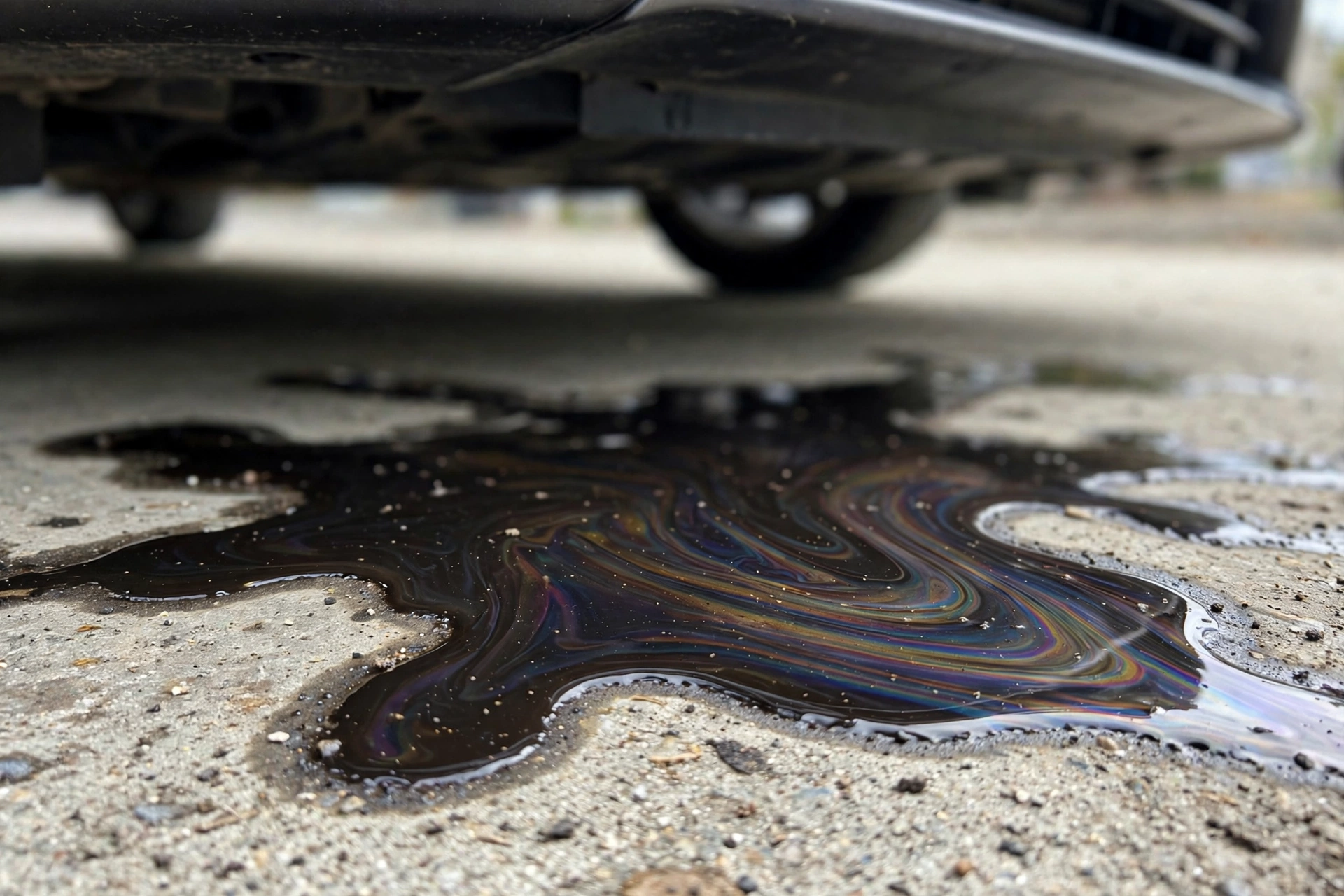
Seeing a dark puddle under your car is never a good sign. A car leaking oil can be a small problem, like a loose drain plug, or a serious one, like a failed rear main seal. The good news is that most leaks are easy to find once you know where to look, and many are cheap to fix if you catch them early. In this guide, you will learn the 10 most common causes of a car leaking oil, how to find the leak yourself, whether it is safe to drive, and how much the repair usually costs.
Table of Contents
How to Tell If Your Car Is Leaking Oil
Before you look for the cause, make sure the leak is really oil. The clearest sign is a dark brown or black puddle under the engine, usually near the front or middle of the car. Oil leaking from a car usually pools right under the engine, near the front or middle. Other signs include the oil level dropping between checks, a burning oil smell when the engine is hot, the oil pressure warning light coming on, and blue smoke from the exhaust.
Check your dipstick first: if the level is low and falling, oil is going somewhere. If you notice a burning smell, read our guide to car smells and what they mean. A car leaking oil does not always leave a puddle — a slow leak can burn off on hot engine parts before it ever reaches the ground.
What Causes a Car to Leak Oil: 10 Causes
Why is my car leaking oil? In most cases, the answer is one of these 10 parts. Gaskets and seals wear out with age and heat, and they are the cause of most leaks.

1. Valve Cover Gasket
The valve cover sits on top of the engine, and its gasket seals the gap. Heat makes the rubber hard and cracked over time, and oil seeps out and runs down the side of the engine. You will often see oil on the top of the engine or smell burning oil when it drips onto the hot exhaust manifold.
2. Oil Pan Gasket
The oil pan holds the engine oil at the bottom of the engine. Its gasket can fail from age, heat, or a loose pan, and oil drips straight onto the ground. This is one of the most common leaks on cars with over 100,000 miles.
3. Loose or Damaged Drain Plug
The drain plug is removed at every oil change. If it is not tightened properly, or if its washer is worn, oil seeps out around the threads. A stripped drain plug leaks even when it feels tight. This is the cheapest leak to fix, and it is often the first thing a mechanic checks.
4. Oil Filter Problems
A loose oil filter, a damaged filter, or a filter fitted with two gaskets leaks oil around its base. This often starts right after an oil change. The filter should be hand-tight plus a quarter turn, and the old gasket must come off with the old filter.
5. Rear Main Seal
The rear main seal sits where the crankshaft leaves the engine to meet the gearbox. When it wears out, oil leaks from the back of the engine, between the engine and the gearbox. It is a small part, but replacing it takes hours of labour, so it is one of the most expensive leaks to fix.
6. Timing Cover Seal
The timing cover protects the timing chain or belt at the front of the engine. Its seal hardens with age and lets oil escape at the front of the engine. You will usually see oil at the front of the engine bay, near the belts.
7. Camshaft Seal
Camshaft seals sit at the ends of the camshaft, usually behind the timing cover. When they wear out, oil leaks from the top front of the engine and can drip onto the timing belt, which should be replaced if it gets soaked in oil.
8. Crankshaft Seal
The front crankshaft seal sits behind the main pulley at the front of the engine. Age and heat make it brittle, and oil leaks out around the pulley. It often looks like a leak from the bottom of the engine, so it is easy to misread.
9. Worn Seals and Gaskets from Age and Heat
Even without one failed part, old rubber seals shrink and harden. Heat cycles, high mileage, and long gaps between oil changes all speed this up. On cars over 10 years old, small seeps from several seals at once are normal, and the fix is to replace the worst ones first.
10. Overfilled Engine Oil
Too much oil is as bad as too little. Overfilling raises the pressure inside the engine and forces oil past seals and gaskets. It can also make the oil foam, which stops it from protecting the engine properly. Always fill to the mark on the dipstick, never above it.
What Colour Is the Leak?
Not every puddle under a car is oil, and the colour tells you what it is. Engine oil is brown or black and feels slippery. Transmission fluid is red or pink. Coolant is green, yellow, or pink and feels slightly sweet and watery. Clear water is usually just condensation from the air conditioning, which is normal. If you are not sure whether the puddle is oil or water, wipe some on white paper: oil leaves a dark brown or black stain, water leaves almost nothing.
Where Is the Oil Leaking From?
The position of the puddle points to the cause. Oil at the front of the engine usually comes from the timing cover or crankshaft seal. Oil in the middle points to the oil pan or drain plug. Oil at the back, between the engine and the gearbox, usually means the rear main seal. Oil on top of the engine comes from the valve cover gasket. To find a car leaking oil, slide a piece of cardboard under the car overnight and mark where the drops fall — it makes the leak much easier to find, and it helps your mechanic too.
Car Leaking Oil When Parked
Most leaks show up when the car is parked, because the oil settles and drips while the engine is off. A few drops overnight is a small leak; a puddle the size of your hand means the leak needs attention soon. Check the ground in the morning before you drive: the size, colour, and position of the spot tell you how serious it is. A car leaking oil when parked is also easier to diagnose, because the puddle sits right under the source.
Car Leaking Oil After an Oil Change
If the leak started right after an oil change, the cause is usually simple: a loose drain plug, a worn drain plug washer, a double oil filter gasket, or overfilled oil. Go back to the shop that did the change — most will check it for free. A car leaking oil after an oil change is rarely a new engine problem; it is usually a fitting that was not done right. Do not ignore it, though: even a small leak can empty the engine over a few hundred miles.
Car Losing Oil But No Leak
Sometimes the oil level drops but there is no puddle at all. In that case, the engine is burning oil instead of leaking it. Worn piston rings, worn valve seals, and a faulty PCV valve all let oil into the combustion chamber, where it burns and leaves as blue smoke from the exhaust. Check for blue smoke when you start the car in the morning. If you see it, the fix is an engine repair, not a gasket — and it is worth getting a mechanic’s opinion before the oil level gets dangerously low.
Can You Drive a Car With an Oil Leak?
It depends on the size of the leak. A few drops a day is a small leak: you can drive short distances if you check the oil level every day and top it up. A steady drip or a puddle is different — do not drive far, and do not drive at all if the oil pressure light comes on or the engine starts to overheat. Oil dripping onto a hot exhaust can also catch fire, so a car leaking oil and smoking needs to stop right away. When in doubt, top up the oil, drive slowly to a mechanic, or call for help.
How to Fix an Oil Leak
A car leaking oil from the drain plug or filter is often a DIY fix. Tighten the drain plug to the torque in your manual, replace a loose oil filter, and top up the oil to the right level. Stop-leak additives can slow a small seal leak, but they are a temporary fix, not a repair — they cannot fix a torn gasket or a failed seal. Gaskets and seals need a mechanic: the parts are cheap, but the labour can be several hours. If you are not sure which part is leaking, find a good mechanic and show them the cardboard with the drip pattern — it saves diagnostic time and money.

How Much Does It Cost to Fix an Oil Leak?
How much does it cost to fix an oil leak in a car? It depends on which part has failed. Typical US car oil leak repair costs are:
- Drain plug or washer: $25–$100
- Oil filter: $30–$80
- Valve cover gasket: $200–$600
- Oil pan gasket: $300–$800
- Timing cover seal: $500–$1,500
- Rear main seal: $500–$1,200
Labour is most of the cost on the bigger jobs, and prices vary by car and by shop. Get two quotes before you agree to a rear main seal or timing cover job, and always ask the mechanic to show you the leak first. A car leaking oil is usually cheap to fix when the cause is a drain plug or filter, and expensive only when the leak is a rear main seal.
Frequently Asked Questions About a Car Leaking Oil
Can you drive a car with an oil leak?
A small leak, yes, for short trips, if you check and top up the oil daily. A big leak, or the oil pressure light on, means stop driving.
Why is my car leaking oil when parked?
Oil settles when the engine is off and drips from the failed gasket or seal. The puddle’s position shows where the leak is.
What does it mean if your car is leaking oil?
It means a gasket, seal, drain plug, or filter is letting oil escape. It is common on older cars and usually fixable.
Can an oil leak cause a fire?
Yes, if oil drips onto the hot exhaust. If you see smoke or smell burning oil, stop and get help.
How long can a car last with an oil leak?
A small leak can go on for months if you keep the oil topped up, but the leak usually gets worse. Fix it before it damages the engine.
Does car insurance cover oil leaks?
No, in most cases. Oil leaks are wear and tear, not an accident, so insurance does not cover them.
Quick Summary: Car Leaking Oil
A car leaking oil usually has a worn gasket or seal, a loose drain plug, or a damaged oil filter. Find the leak by checking the colour and position of the puddle, fix small problems early, and do not drive with a big leak or the oil pressure light on.

