

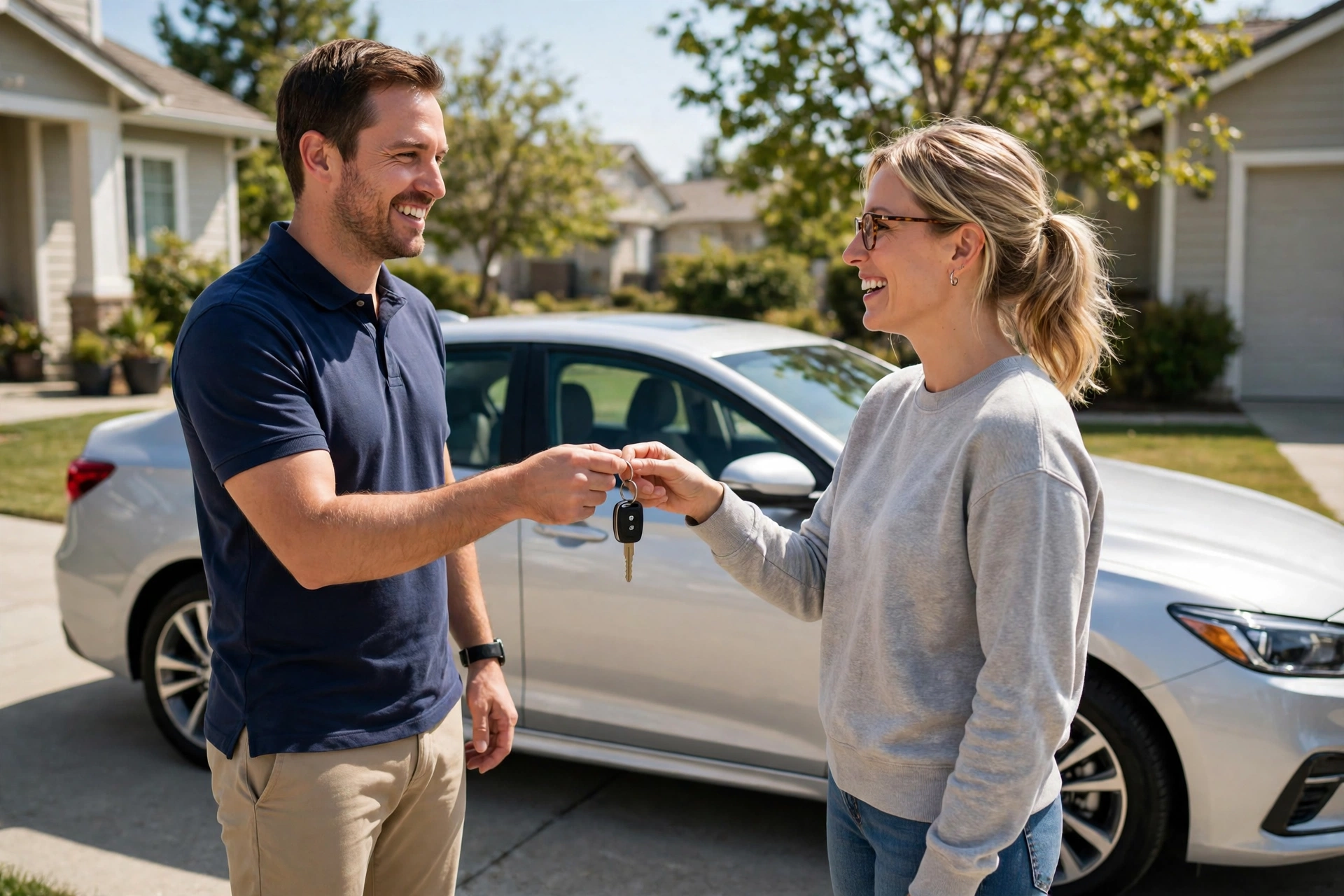
Selling your car to a dealer is easy, but it is rarely the best deal. A private sale usually puts hundreds — sometimes thousands — more in your pocket, because there is no dealer margin in the middle. The trade-off is that you do the work yourself: pricing, photos, paperwork and payment.
So how do you sell your car privately without the hassle? Start by checking your car’s value with Kelley Blue Book and local listings, then clean it, photograph it in daylight, and write an honest ad. Meet buyers in a safe public place, let them test drive with you along, and accept only verified payment before you sign over the title. This guide walks you through how to sell your car privately in 9 simple steps, from your first price check to the final handshake.
Table of Contents
Is Selling Your Car Privately Worth It?
For most owners, yes — if you have a little patience. A dealer has to resell your car at a profit, so a trade-in offer is almost always below what a private buyer will pay. On a car worth $10,000, the gap is often $1,000 to $2,000.
A private sale also gives you control. You set the price, choose the buyer and decide when the deal happens. The downsides are real, though: you will spend time answering messages, meeting strangers and handling paperwork. If your car needs major repairs, or you need it gone this weekend, a dealer or instant-cash buyer may be the better call.
Here is a quick comparison:
- Private sale: highest price, more time, you handle the paperwork.
- Trade-in: fast and simple, but usually the lowest price.
- Instant cash buyer: quick, but the offer sits between trade-in and private sale.
If you can spare a week or two, learning how to sell your car privately is usually worth the effort.
How to Sell Your Car Privately in 9 Steps
Follow these steps in order and the sale will go far more smoothly.
Step 1: Decide If a Private Sale Suits You
The first part of learning how to sell your car privately is deciding whether a private sale suits you at all. Check two things. First, do you own the car outright, or is there still a loan on it? If you still owe money, you will need to pay off the loan — or arrange the payoff with your lender — before you can hand over a clean title. Second, is the car in a condition a private buyer would want? A car that runs well and looks tidy will sell fast. A car with a dead transmission will not, and a dealer may be the realistic option.
Step 2: Gather Your Paperwork First
Nothing kills a sale faster than missing paperwork. Paperwork is the unglamorous part of how to sell your car privately, but it comes first for a reason. Before you list the car, collect the title, your service and repair records, and any warranty documents. If you have lost the title, order a replacement from your state’s DMV now — it can take weeks. A bill of sale protects both sides, so prepare one with the buyer and seller names, the price, the date, the VIN and both signatures. Our guide to the documents needed to buy a used car lists the same papers from the buyer’s side, which is a useful double-check.
Step 3: Price Your Car the Right Way
Pricing is where most sellers go wrong. Price too high and nobody calls. Price too low and you give money away. Start with Kelley Blue Book’s free valuation tool to get a private-party range for your exact year, trim, mileage and condition. Then check what similar cars are actually listed for in your area on Facebook Marketplace and Craigslist — asking prices there show you the real competition.
Set your asking price a little above the lowest price you will accept, so there is room to negotiate. A good rule is 5 to 10 percent above your floor. And be honest with yourself about condition: a car with worn tyres and a stained interior is not a “like new” car, and buyers will notice. Knowing how to sell your car privately starts with knowing what your car is truly worth.
Step 4: Clean and Detail Your Car
First impressions sell cars, and a clean car is one of the cheapest wins in how to sell your car privately. A clean car photographs better, smells better and makes buyers trust that it was looked after. Wash and wax the outside, clean the wheels, vacuum the interior, wipe down the dashboard and remove all personal items. Shampoo the seats and mats if they are stained, and clear out the boot. A $30 bottle of interior cleaner and an afternoon of work can easily add hundreds to your sale price.
Fix small, cheap things too: a burnt-out bulb, a missing hubcap, a cracked wiper blade. Leave major repairs alone — a buyer will not pay you back for a $1,000 repair, and it is better to price the car fairly and be upfront about it. That honesty is part of how to sell your car privately the right way.

Step 5: Take Great Photos
Your photos are your advert, and every guide on how to sell your car privately agrees on this: daylight and honesty win. Take at least 15 to 20 shots in bright daylight, on a clean background, with the car facing the sun. Include the front, back, both sides, all four wheels, the engine bay, the boot, the dashboard, the seats and the odometer. Then photograph every scratch, dent or stain honestly. Buyers who find a flaw in person that was hidden in the photos lose trust fast — and often walk away.
Take the photos after the car is cleaned, not before. A tidy car in good light can be the difference between a buyer messaging you or scrolling past.
Step 6: Write a Strong, Honest Listing
A good listing answers the questions a buyer will ask before they ask them — it is the heart of how to sell your car privately, because it does the selling while you are at work. Include the year, make, model, trim, mileage, engine and transmission, service history, recent repairs, and the reason you are selling. Mention the good and the bad. “New brakes last year, small scratch on the rear bumper” builds far more trust than “runs great, no issues.”
List on Facebook Marketplace and Craigslist first — both are free and reach local buyers — and consider Autotrader if you want a wider audience. Where you list matters less than how you list: a clear, honest advert is what makes how to sell your car privately work. Use the same clear title everywhere: year, make, model and one selling point, for example “2018 Honda Civic LX — One Owner, Full Service History.”
Step 7: Handle Enquiries and Test Drives Safely
Safety is the part of how to sell your car privately that new sellers worry about most — and it is the easiest part to get right. Expect messages, and expect some of them to be time-wasters. Ask serious buyers a few questions before you meet: are they paying cash or financing, and when can they view the car? Ignore lowball offers sent without a viewing and anyone who asks you to ship the car or accept an overpayment cheque — those are classic scams.
Always meet in a safe, public place in daylight, such as a busy car park or outside a police station. Bring a friend if you can. Ask to see the buyer’s driving licence before the test drive, and always ride along. Our guide on how to test drive a used car explains what a careful buyer will check, so you will know what to expect.
Step 8: Negotiate With Confidence
Most buyers will try to negotiate, and that is normal. Decide your lowest acceptable price before you meet anyone, and do not reveal it. If a buyer points out a real flaw, a small discount is fair. If they offer far below your price without a reason, thank them and wait for the next buyer. Patience is part of how to sell your car privately — the right buyer is usually only a few days away.
Our guide on how to negotiate used car price has more tactics, and they work just as well from the seller’s side of the table. Stay polite, stay firm, and never let anyone pressure you into a same-day decision you are not comfortable with.
Step 9: Get Paid Safely and Transfer the Title
This is the step that matters most. Payment is the final step in how to sell your car privately, and the one where carelessness costs the most. Never hand over the keys or the signed title until the money is in your account and verified. The safest options are cash at your bank, where the teller can check the notes, or a bank transfer that you can see has cleared. A cashier’s cheque is only safe if you verify it with the issuing bank — never accept a personal cheque, a money order, or a payment app transfer from a stranger.
Once payment is confirmed, sign the title over to the buyer, fill in the exact mileage, and complete a bill of sale in two copies — one for each of you. Then notify your DMV or state motor vehicle agency that you have sold the car, and cancel your insurance. Many buyers will want to check a used car’s history before buying, so having your service records ready at this point makes the handover quick and easy.

Mistakes to Avoid When You Sell Your Car Privately
Most problems in how to sell your car privately come from rushing one of the steps above. Watch out for these:
- Accepting payment before it clears. A cheque can bounce days after the car is gone.
- Letting a buyer test drive alone. Always ride along, and hold their licence or keys during the drive.
- Hiding known faults. In many states you can be liable if you hide a serious problem. Honesty protects you.
- Skipping the bill of sale. Without it, you have no proof of the price, date or condition at sale.
- Forgetting to notify the DMV. Until the transfer is recorded, tickets and tolls can still come to you.
- Pricing on emotion. What you paid, or what you spent on repairs, does not set the market value.
Quick Summary
- How to sell your car privately, in short: price it right, clean it, photograph it honestly, meet buyers safely, and take verified payment only.
- A private sale usually earns $1,000 to $2,000 more than a trade-in on a $10,000 car.
- Price your car with Kelley Blue Book plus local listings, then ask 5 to 10 percent above your lowest acceptable price.
- Gather the title, service records and a bill of sale before you list the car.
- Clean, detail and photograph the car in daylight — at least 15 to 20 honest photos.
- Meet buyers in public, in daylight, and always ride along on test drives.
- Accept only verified payment — cash at the bank or a cleared bank transfer — before signing over the title.
- Notify the DMV and cancel your insurance as soon as the sale is done.
Frequently Asked Questions
How long does it take to sell a car privately?
Most people who learn how to sell your car privately find the car sells within one to two weeks. A popular model in good condition can sell in a few days, while a niche car or an overpriced one can take a month. If you get no enquiries in a week, your price is probably too high.
Do I need to fix everything before selling my car privately?
No. Fix cheap, visible things like bulbs and wiper blades, and give the car a deep clean. Leave expensive repairs alone and price the car fairly instead — buyers prefer a lower price and an honest description over a patched-up car with hidden problems. That is the honest approach to how to sell your car privately: price the car for its real condition.
Is it safe to sell your car privately?
Yes, if you follow basic safety rules. How to sell your car privately and stay safe comes down to simple habits. Meet in a public place in daylight, bring a friend, ride along on test drives, and accept only verified payment. Never meet a buyer at your home alone at night, and never accept a cheque you have not verified with the bank.
What paperwork do I need to sell my car privately?
The paperwork for how to sell your car privately is simple. You need the vehicle title in your name, a bill of sale, and your service records. Some states also require an emissions or safety certificate and a release of liability form. Check your state DMV’s website for the exact list before you list the car.
Should I let a buyer take the car to a mechanic?
Yes — a serious buyer who pays for a pre-purchase inspection is a good sign. Agree on a nearby workshop, go with them, and let the mechanic’s report speak for itself. It builds trust and often closes the sale.
Final Thoughts
Learning how to sell your car privately is mostly about preparation: the right price, a clean car, honest photos, and safe payment. Do those four things well and you will usually come away with far more money than a trade-in would have paid. Take your time, trust the process, and do not hand over the keys until the money is verified. Follow these 9 steps and you will know exactly how to sell your car privately the next time you need to, too. If you are also thinking about what to buy next, our list of the best used cars under $10000 is a good place to start.

