

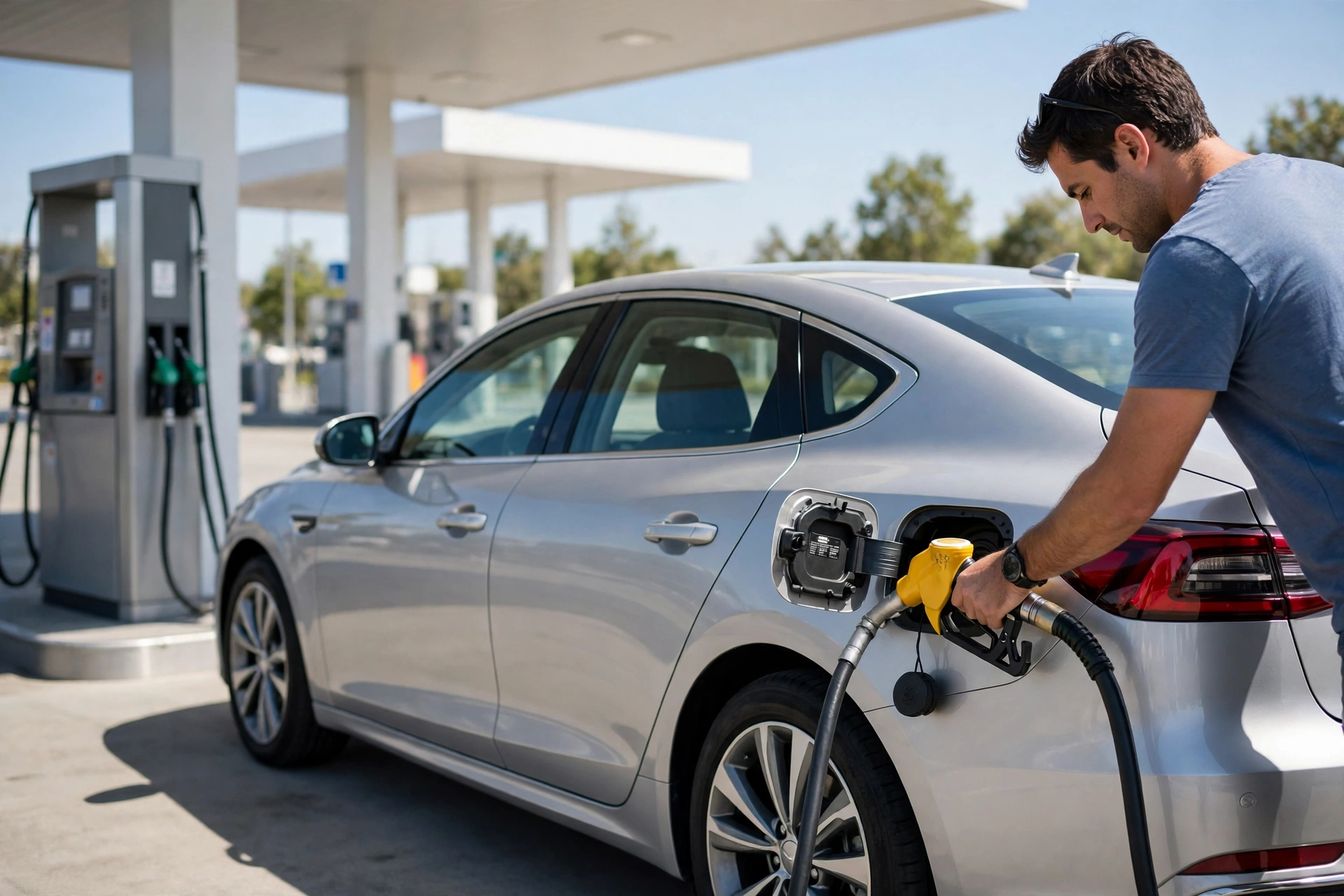
If you want to spend less at the pump, the good news is that learning how to improve fuel economy does not require a new car or expensive parts. Most of the fuel your car wastes comes from small, everyday habits — hard braking, speeding, under-inflated tyres and skipped maintenance. Change a few of those habits and you can cut your fuel use noticeably, often by 10 to 30 percent on the same car. This guide explains how to improve fuel economy with 15 simple, proven ways that work on almost any petrol or diesel car, starting with the ones that save the most.
Table of Contents
1. Drive Smoothly to Improve Fuel Economy
The single biggest factor in how to improve fuel economy is how you use the pedals. Hard acceleration and sudden braking waste fuel, because every burst of speed you throw away at the next red light has to be bought back with more petrol. Anticipate traffic, lift off the gas early when you see a light turn red, and accelerate gently from a stop. Smooth, steady driving can improve your fuel use by 10 to 40 percent in stop-and-go traffic, according to the U.S. Department of Energy’s fuel economy guidance, and it also makes your brakes and tyres last longer.

2. Slow Down on the Highway
Speed is expensive. Most cars reach their best fuel efficiency between 50 and 60 mph, and fuel economy drops at higher speeds because wind resistance rises sharply. Driving at 75 mph instead of 65 can use around 20 percent more fuel over the same distance. On the highway, staying closer to the speed limit is one of the easiest answers to how to improve fuel economy, and it costs you only a few minutes on most trips.
3. Keep Your Tyres at the Right Pressure
Under-inflated tyres are one of the most common reasons cars waste fuel. Soft tyres roll with more resistance, so the engine works harder to keep the car moving. Check your tyre pressure at least once a month, when the tyres are cold, and inflate them to the pressure shown on the driver’s door sticker — not the maximum printed on the tyre sidewall. Correct pressure can improve fuel use by up to 3 percent, and it also helps your tyres wear evenly. If you are unsure about the condition of your tyres, read our guide on how to tell if tyres need replacing.

4. Lighten the Load and Cut Drag
Every extra kilogram your car carries costs fuel, especially in town driving with lots of stopping and starting. Clear out heavy items you do not need from the boot, and take off a roof rack or roof box when you are not using it — a loaded roof rack can cut fuel economy by several percent at highway speed. A roof box creates drag even when it is empty, so store it in the garage between trips. This is a simple, free answer to how to improve fuel economy that many drivers overlook.
5. Service Your Car on Time
A car that is overdue for service burns more fuel. A dirty air filter, old spark plugs or worn engine parts all make the engine work harder than it should. Follow your car maintenance schedule by mileage for oil changes, air filters and spark plugs, and fix a check-engine light promptly — a faulty oxygen sensor alone can cut fuel economy by a large amount. A well-serviced engine is central to how to improve fuel economy over the long term, and regular servicing is one of the most reliable ways to keep your car running at its best.
6. Use the Right Engine Oil
Engine oil is not one-size-fits-all. Your owner’s manual lists the grade your engine was designed for, such as 0W-20 or 5W-30. Using the recommended grade reduces friction inside the engine, and the U.S. Department of Energy notes that the right oil can improve fuel economy by 1 to 2 percent. Choosing the right oil is a small part of how to improve fuel economy, but it costs nothing extra. Using a thicker oil than recommended does the opposite.
7. Cut Idling and Short Trips
An idling engine burns fuel and gets you nowhere. If you are parked and waiting for more than a minute, switch the engine off — restarting uses less fuel than idling for that long. Short trips are costly too: a cold engine uses much more fuel for the first few miles, so several short trips in a day use far more fuel than one combined trip. Where you can, walk for very short journeys, and combine errands into a single outing. Knowing how to improve fuel economy is often about cutting the fuel you burn while going nowhere.
8. Use Cruise Control on the Highway
On flat, open highways, cruise control helps you hold a steady speed instead of drifting faster and slower. That steadiness saves fuel, because constant small speed changes waste energy. Cruise control is one of the simplest tools for how to improve fuel economy on long trips. Use cruise control on long, quiet stretches of motorway, but switch it off in heavy traffic, rain or hilly roads, where you need full control. In hilly country, gentle manual speed control can beat cruise control, so use your judgment.
9. Plan Your Trips and Combine Errands
Route planning sounds dull, but it saves real fuel. A shorter route with fewer stops beats a longer one, and one warm-engine trip beats three cold starts. Before you drive, check traffic and pick the route with the least congestion, even if it is a mile longer — sitting in traffic burns fuel with nothing to show for it. Combining errands into one trip is one of the easiest habits in how to improve fuel economy, and it saves your time as well.
10. Use Air Conditioning Wisely
Air conditioning puts an extra load on the engine, especially in small cars and in slow traffic. At low speeds around town, opening the windows is usually more efficient. At highway speed, the opposite is true: open windows create drag, so air conditioning is the better choice. Use the recirculation setting once the cabin is cool, and park in the shade when you can so the car starts cooler. On very hot days, remember that an overheated engine wastes fuel too — see what to do when your car overheats if your temperature gauge climbs.
11. Shift Early and Use Eco Mode
If you drive a manual, shift up early — around 2,000 to 2,500 rpm for most petrol cars — and keep the engine in the highest gear that still feels comfortable. Labouring the engine in too high a gear wastes fuel too, so find the balance. If your car has an Eco mode, use it for everyday driving: it softens throttle response and can adjust the air conditioning to save fuel. Eco mode is a built-in shortcut for how to improve fuel economy without changing your route. It will not turn a thirsty car into an efficient one, but it helps.
12. Keep Your Fuel Cap Tight
A loose or damaged fuel cap lets petrol vapour escape and can trigger a check-engine light. It sounds trivial, but a missing or cracked cap wastes fuel every day your car sits and drives. After filling up, click the cap until it is tight, and replace it if the seal is cracked or it no longer clicks. A tight fuel cap is a tiny detail in how to improve fuel economy, but it is free to fix. This is the cheapest fix on the whole list.
13. Choose the Right Fuel
Most cars are designed to run on regular unleaded petrol, and putting premium fuel in a car that does not need it does not improve fuel economy or performance. The honest answer to how to improve fuel economy is not more expensive fuel — it is the fuel your manual recommends. Check your owner’s manual: only use a higher octane if the manufacturer requires it. The one exception is a car that specifically calls for premium — in that case, using regular fuel can hurt efficiency. Do not pay extra for fuel your engine cannot use.
14. Check Your Wheel Alignment
If your car pulls to one side, or your tyres wear unevenly on one edge, your wheels may be out of alignment. Misaligned wheels fight each other as they roll, which increases resistance and wastes fuel. Proper alignment is part of how to improve fuel economy that many drivers only discover after new tyres wear out early. Potholes, kerb strikes and worn suspension parts can knock the alignment out. A wheel alignment check is quick and cheap at most tyre shops, and it protects your tyres as well as your fuel budget.
15. Track Your Fuel Use
You cannot improve what you do not measure. Keep a simple log of your fill-ups: note the mileage and the litres or gallons at each fill, and work out your fuel use every few weeks. Tracking is how you prove that advice on how to improve fuel economy is actually working for your car. A free phone app can do the maths for you. Tracking shows you which habits actually save fuel and warns you early if something changes — a sudden drop in fuel economy is often the first sign of a problem, such as a sticking brake or a faulty sensor.
Winter driving makes tracking even more useful: cold weather and snow tyres change your numbers, so see our guide on how to drive in snow for beginners before the cold season arrives.
Quick Summary: How to Improve Fuel Economy
- Drive smoothly, brake gently and anticipate traffic.
- Slow down on the highway — most cars are most efficient near 50 to 60 mph.
- Keep tyres at the correct pressure and check them monthly.
- Remove roof racks and heavy items you do not need.
- Service your car on time and use the recommended engine oil.
- Switch off when idling, combine short trips, and plan routes.
- Use cruise control on flat highways and Eco mode in town.
- Track your fuel use so you can see what is working.
Frequently Asked Questions
How much can I save by improving fuel economy?
Most drivers can cut fuel use by 10 to 30 percent by combining smooth driving, correct tyre pressure and regular maintenance. If you are wondering how to improve fuel economy on a tight budget, start with the free habits — smooth driving, tyre pressure and slower highway speeds — before spending anything. On a car that uses 500 litres of fuel a year, that can mean 50 to 150 litres saved — a real saving at today’s prices.
Does premium fuel improve fuel economy?
Not unless your car is designed for it. If your owner’s manual says regular unleaded, premium fuel will not improve fuel economy. Only cars that require high-octane fuel benefit from it.
How do I calculate my car’s fuel economy?
Fill the tank, reset the trip meter, and drive normally. At the next fill, divide the miles driven by the gallons used (or the kilometres by the litres, then convert). Repeat over a few tanks for a reliable average.
Does air conditioning use a lot of fuel?
It uses some fuel, mainly at low speeds. Around town, open windows are more efficient; on the highway, air conditioning beats open windows because of drag. Use the recirculation setting to reduce the load.
How often should I check tyre pressure?
At least once a month, and before long trips. Tyres lose pressure slowly over time, and cold weather drops it further, so a monthly check is the simplest habit for better fuel economy.
Conclusion
Learning how to improve fuel economy comes down to three things: drive smoothly, keep the car in good condition, and cut the fuel you waste while idling or carrying drag. None of the 15 steps above costs much — most are free — and together they can save you a noticeable amount of money every year while making your car last longer. Start with the biggest wins: gentle acceleration, correct tyre pressure and a steady highway speed. Track your fuel use for a month, and you will see the difference for yourself.


[…] weekends. A car that gets 30 miles per gallon or more keeps your weekly fuel bill small, and you can improve your fuel economy further with simple habits like gentle acceleration and correct tyre […]
[…] is real money on every trip, and fewer fuel stops means fewer interruptions. Small habits can also improve your fuel economy on the road, from steady speeds to keeping tyres at the right […]
[…] the equipment, costs and options in detail. And if you still run a gas car as well, our guide on how to improve fuel economy covers 15 habits that cut fuel use and save money at the […]