
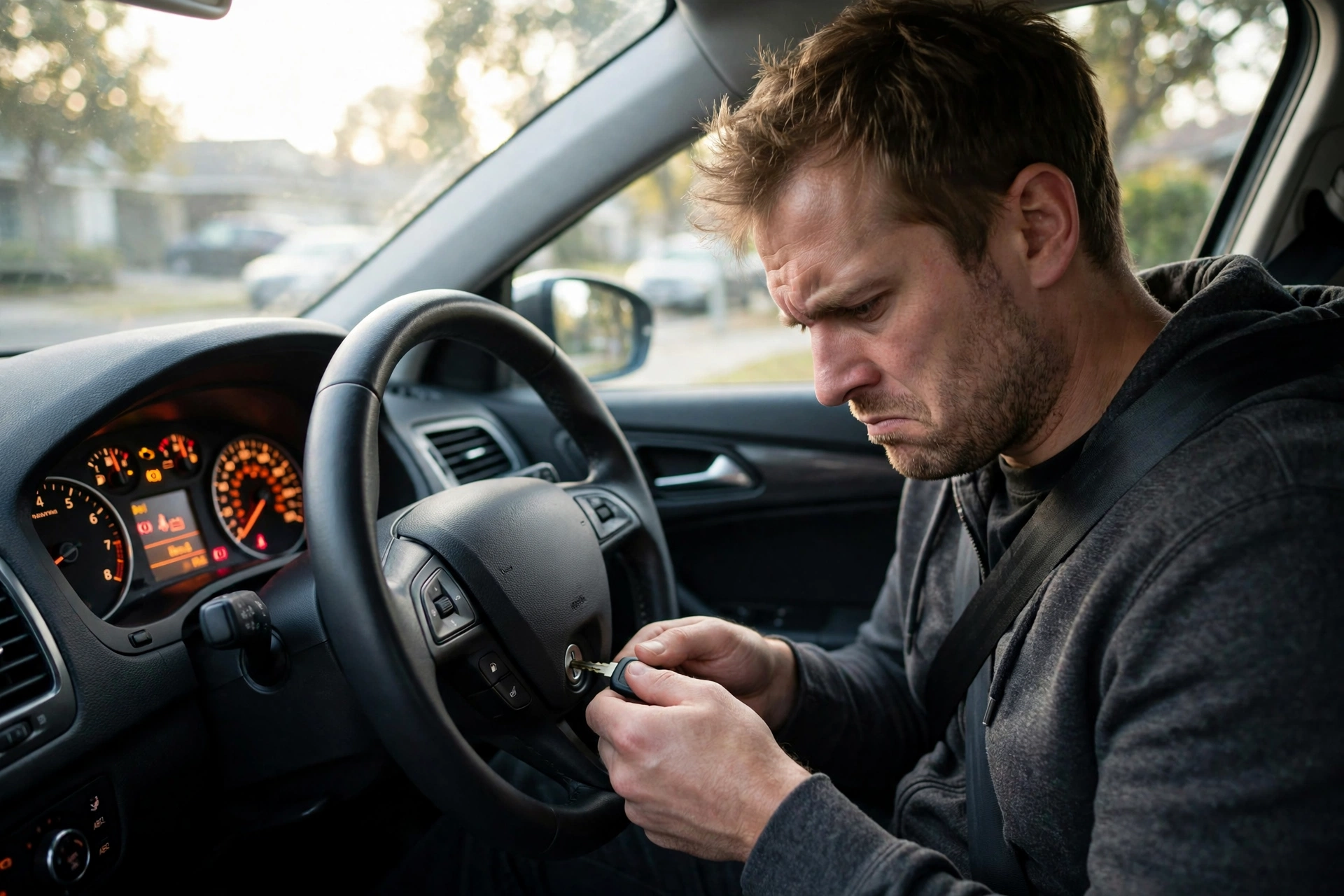

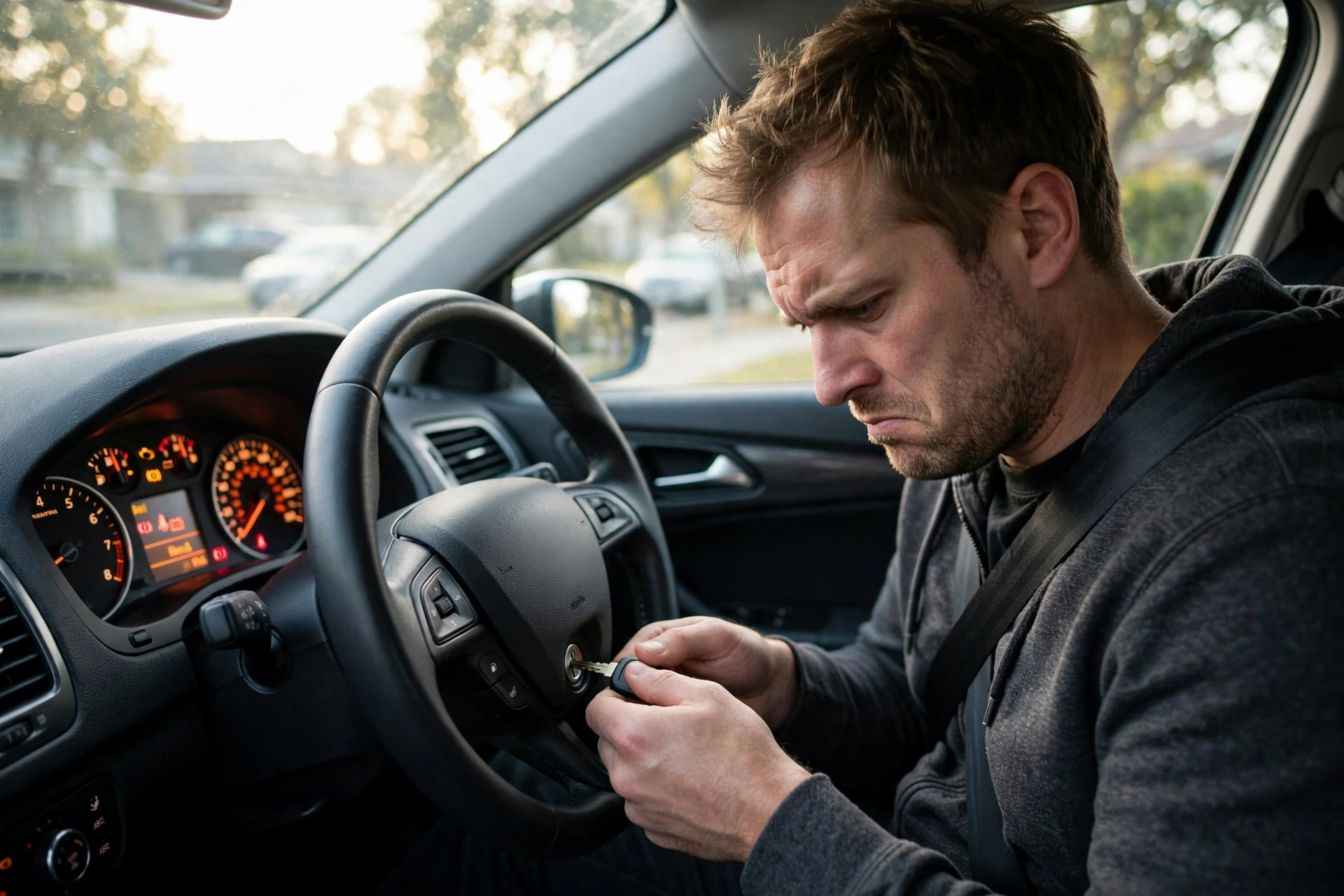
When your car refuses to start, the first thing to know is that most no-start problems have a simple cause and a simple fix. If you are wondering what to do if your car won’t start, start with the basics: check the gear selector, the key fob battery and the battery terminals, then listen to the sound the car makes when you turn the key. In most cases, what to do if your car won’t start comes down to a dead or weak battery, and a jump start or a terminal clean gets you moving again. This guide walks you through 9 easy steps in order, so you can find the problem fast.
Table of Contents
First, Stay Calm and Check the Basics
A car that will not start feels like an emergency, but rushing usually makes things worse. Before you touch anything under the hood, run through the quick checks below. Knowing what to do if your car won’t start starts with ruling out the simple mistakes that catch even experienced drivers.
- Is the car in Park or Neutral? An automatic car will not start in Drive or Reverse. Push the gear selector firmly into Park and try again. With a manual car, press the clutch pedal all the way down.
- Is the steering wheel locked? If the wheel will not move and the key will not turn, the steering lock is engaged. Gently wiggle the wheel left and right while you turn the key.
- Is the key fob battery dead? A push-button car may not recognise a fob with a flat battery. Hold the fob against the start button and press it, or use the hidden physical key inside the fob.
- Are the lights and radio working? If nothing electrical works at all, the battery is almost certainly dead or disconnected. If the lights are bright, the battery is probably fine and the problem lies elsewhere.
These four checks take less than a minute, and they solve the problem more often than you might expect. If they do not help, the next step in working out what to do if your car won’t start is to listen carefully, because the sound your car makes is the best clue you have.
Listen to What Your Car Is Telling You
Every no-start problem sounds a little different, and each sound points to a different cause. Pay attention the next time you turn the key, because the answer to what to do if your car won’t start often depends on what you hear.
- Nothing at all — no sound, no lights: the battery is completely dead, a cable is loose, or a main fuse has blown.
- A rapid clicking sound: the classic sign of a weak battery. There is enough power for the starter relay to click, but not enough to turn the engine over.
- One loud click, then silence: the starter motor or its solenoid may have failed, or a battery cable is badly corroded.
- The engine cranks normally but will not fire: the battery and starter are fine. The problem is usually fuel, spark or a sensor — for example, an empty tank, a failed fuel pump or a bad crankshaft sensor.
- A grinding or whirring noise: the starter gear may not be engaging the flywheel properly. Stop cranking and call a mechanic, because continuing can damage the flywheel.
- The engine starts, then dies straight away: this can point to a faulty immobiliser, a bad fuel pump or a serious sensor problem.
Write down what you heard before you move on — it will save time if you end up calling roadside assistance or a mechanic.

9 Steps: What to Do If Your Car Won’t Start
Work through these steps in order. Most drivers find the fix in the first four, and the later steps tell you when it is time to call for professional help.
Step 1: Check the Gear, the Key and the Battery in the Fob
Confirm the car is in Park (or Neutral with the clutch down in a manual), the steering wheel is not locked, and the key fob is working. If you have a spare key, try that too — a worn key or a failing fob can stop a car from starting even when everything else is healthy.
Step 2: Inspect the Battery and Its Terminals
Pop the hood and look at the battery. Corrosion shows up as a white, blue or green crust around the terminals, and it can block enough current to stop the car from starting. A weak battery is the most common answer to what to do if your car won’t start, so check that both cables are tight — you should not be able to wiggle them by hand. If you want to test the battery properly, our guide on how to test a car battery at home shows five easy methods, including the headlight test and a multimeter check.
Step 3: Clean Corroded Battery Terminals
If you see corrosion, disconnect the negative cable first (black, marked with a minus sign), then the positive cable (red, marked with a plus sign). Cleaning the terminals is one of the quickest fixes in what to do if your car won’t start: scrub the terminals and cable ends with a wire brush and a mix of baking soda and water, rinse lightly, dry them, and reconnect the positive cable first, then the negative. Tighten both clamps firmly and try to start the car.
Step 4: Jump Start the Car
If the battery is weak, a jump start is the next step. You need jumper cables and a second car with a healthy battery, or a portable jump starter. Connect red to the dead battery’s positive terminal, red to the good battery’s positive terminal, black to the good battery’s negative terminal, and the last black clamp to an unpainted metal surface on the dead car, away from the battery. Start the donor car, wait a few minutes, then try your car. Knowing what to do if your car won’t start means knowing how to jump start safely, so read our full guide on how to jump start a car before you connect the cables. Once the car is running, drive it for at least 20 to 30 minutes so the alternator can recharge the battery — but if the battery dies again the next morning, it probably needs replacing.
Step 5: Check the Fuel Level
It sounds obvious, but an empty tank is a common cause, especially if the fuel gauge is faulty. Part of what to do if your car won’t start is ruling out the simplest cause of all, so if the gauge reads empty or the low-fuel light has been on for a while, add a gallon or two of fuel and try again. On some cars, the fuel gauge can stick, so the tank may be empty even when the needle says otherwise. If the car cranks strongly but never fires, lack of fuel is one of the first things to rule out.
Step 6: Check the Fuses
A blown fuse can cut power to the fuel pump, the ignition or the starter. Checking the fuses is a quick part of what to do if your car won’t start, and your owner’s manual shows where the fuse boxes are — usually one under the hood and one under the dashboard — and which fuse does what. Pull the fuse for the fuel pump or ignition and hold it up to the light: if the metal strip inside is broken, the fuse is blown. Replace it with a fuse of the same rating (never a higher one), and try to start the car. Keep a few spare fuses in the glove box for next time.
Step 7: Try the Steering Wheel and Ignition Again
If the key will not turn at all, you are dealing with a different part of what to do if your car won’t start: the ignition itself. Make sure the steering wheel is not putting pressure on the lock, try your spare key, and check that nothing is stuck in the key slot. For push-button cars, press the brake pedal firmly and hold the fob against the button. If the button still does nothing, the brake-light switch — which tells the car your foot is on the brake — may have failed.
Step 8: Tap the Starter Motor (Carefully)
A starter motor with worn brushes can sometimes be coaxed back to life with a gentle tap from a hammer or a wrench while someone else turns the key. This is only a temporary trick to get you to a mechanic, not a repair. If a single loud click is all you hear, the starter is a strong suspect. Do not keep cranking for more than 10 seconds at a time.
Step 9: Call Roadside Assistance or a Mechanic
If none of the steps above work, it is time for professional help. Call roadside assistance, or a trusted local garage — our guide on how to find a good mechanic explains what to look for in a trustworthy repair shop. Tell them exactly what the car does when you try to start it: the sounds you heard, whether the lights work, and what you have already tried. Some no-start causes are covered by safety recalls, too — you can check for open recalls on the NHTSA website for free using your VIN.
What to Do If Your Car Won’t Start in Cold Weather
Cold weather is the hardest season for a car battery. At freezing temperatures, a battery loses a large share of its cranking power, while thick, cold engine oil makes the engine harder to turn over. If you are facing what to do if your car won’t start on a cold morning, try the steps above, but keep these cold-weather tips in mind. For a full seasonal checklist, see our guide on how to prepare your car for winter.
- Turn off everything electrical — headlights, heater, heated seats and radio — before you crank, so all the battery’s power goes to the starter.
- Crank in short bursts of no more than 10 seconds, with a minute of rest between tries.
- Keep the car plugged in if it has a block heater, and use it on nights below freezing.
- Park in a garage when you can. Even an unheated garage keeps the battery several degrees warmer than the open driveway.
- Replace an old battery before winter. A battery that struggles in autumn will almost certainly fail on the first really cold morning, so winter preparation is the best way to avoid standing in the cold with a car that will not start.

What to Do If Your Car Won’t Start After Sitting for a Long Time
A car left parked for weeks or months often will not start, and the reasons are different from a daily driver’s. The battery slowly drains while the car sits and fuel goes stale. If you are working out what to do if your car won’t start after a long break, check the battery first — it is the cause nine times out of ten — then check the fuel and the oil level before you crank. If the car has been sitting for more than a few months, do not force it: charge or replace the battery, check the fluids, and look for signs of rodents chewing wires. Following a regular car maintenance schedule by mileage and by time is the best way to keep a little-used car ready to go.
When to Call a Mechanic Straight Away
Some no-start problems are not safe or sensible to fix yourself. If you have worked through the steps above and still do not know what to do if your car won’t start, call a mechanic right away if you notice any of the following.
- You smell fuel strongly, or you see fuel leaking under the car.
- There is smoke, or a burning smell, coming from under the hood.
- The engine makes a loud grinding, knocking or metal-on-metal noise.
- The car starts and then stalls repeatedly, or the check engine light flashes.
- You have tried jump starting and the battery dies again within minutes.
- You are stranded somewhere unsafe — a busy road, a bad neighbourhood or extreme weather. Move to a safe place first, then call for help.
A flashing check engine light means the engine is misfiring badly enough to damage the catalytic converter, so do not keep driving or cranking. Getting the car towed is cheaper than the repair bill that follows.
How to Prevent a No-Start in the Future
Once your car is running again, a little prevention goes a long way. A no-start is rarely a surprise — the car usually gives warning signs first, and catching them early is the cheapest fix of all.
- Test the battery twice a year, in spring and autumn, and replace it before it fails rather than after — most batteries last three to five years, so learn how long a car battery lasts and plan the replacement ahead of time.
- Clean the terminals whenever you see corrosion building up.
- Drive the car regularly. Short trips do not fully recharge the battery, so take a longer drive at least once a week.
- Listen for slow cranking. If the engine turns over more slowly than usual, the battery or starter is getting weak.
- Fix small problems early. A flickering dashboard light or a key that sometimes does not turn will not fix itself.
- Keep jumper cables and a flashlight in the car, along with your roadside assistance number, so you are ready the next time you face what to do if your car won’t start.
Regular maintenance is the real answer to what to do if your car won’t start — because the best version of the problem is the one that never happens. A battery test, a terminal clean and a quick look at the belts and fluids cost little, and they save you from the worst kind of morning. And if you ever forget the steps, remember the order: battery, terminals, jump start, fuel, fuses — that is what to do if your car won’t start, every time.
Frequently Asked Questions
Why won’t my car start but the lights work?
If the lights and radio work but the engine will not crank, the battery probably has enough power for small loads but not enough to turn the starter — or the starter itself has failed. Try a jump start first. If that does not help, the starter motor, the ignition switch or a bad connection is the likely cause. If you are still unsure what to do if your car won’t start at that point, call a mechanic rather than guessing.
Why is my car clicking but not starting?
A rapid clicking sound almost always means a weak battery — it is the most common sound drivers hear when they ask what to do if your car won’t start. The starter relay clicks, but there is not enough power to turn the engine. Jump start the car and drive it for at least 20 minutes. If the problem returns the next day, the battery needs testing and probably replacing.
Can a bad key fob stop my car from starting?
Yes. A push-button car will not start if it cannot detect the fob, and the most common cause is a dead fob battery. Hold the fob against the start button and press it — most cars have a backup sensor there — or use the physical key hidden inside the fob. Replacing the small coin battery in the fob usually fixes it.
How long should I try to jump start a car before giving up?
Let the donor car run for three to five minutes with the cables connected, then try to start your car. If it does not start after two or three tries, stop — repeated cranking drains both batteries and can overheat the starter. At that point the problem is probably not the battery, and you should call for help.
Is it safe to jump start a car in the rain?
Yes, jump starting in light rain is safe — car electrical systems are built to handle wet weather. Keep the battery terminals and cable clamps as dry as you reasonably can, and never jump start a battery that is cracked, leaking or swollen. If the battery case is damaged, call a professional instead.
What does it mean if my car cranks but won’t start?
Cranking without firing usually means the engine is not getting fuel or spark, and it is a common version of the problem. Check the fuel level and the fuel pump fuse first — those are the first two checks in what to do if your car won’t start when the engine turns over but never catches. Beyond that, the cause could be a failed fuel pump, a bad crankshaft position sensor or an ignition fault, and these need a mechanic’s diagnostic tools to pin down.
Quick Summary
Here is the short version of what to do if your car won’t start:
- Start with the basics: gear in Park, steering wheel unlocked, key fob working.
- Listen to the sound — silence, clicking, cranking or grinding each point to a different cause.
- A weak or corroded battery is the most common reason, and a jump start or terminal clean often fixes it.
- Check the fuel level and the fuses before assuming the worst.
- Do not keep cranking for more than 10 seconds at a time.
- Call a mechanic if you smell fuel, see smoke, hear grinding, or the check engine light flashes.
- Prevent the next no-start with twice-yearly battery tests and regular maintenance.
- If you are still unsure what to do if your car won’t start, call for help rather than guessing.
Conclusion
Now you know what to do if your car won’t start: stay calm, check the simple things first, listen to what the car is telling you, and work through the steps in order — battery, terminals, jump start, fuel and fuses. Most of the time, the fix is a jump start or a clean connection, and you will be on your way in minutes. But if the car still will not start, or you notice fuel smells, smoke or grinding noises, do not force it — call roadside assistance or a trusted mechanic. Keep your battery tested, your terminals clean and your jumper cables in the boot, and the next time you wonder what to do if your car won’t start, you will already have the answer.

